Can We Live Without Sin?
This question is one of the key questions of Christianity because it stands at the very center of God's plan of redemption for mankind.
Dear reader, the answers to this question may seem unpopular to you. Before you close this page, however, please examine every argument in the light of the Scriptures. This question is of great importance and far-reaching in its scope; therefore it requires patience and careful study. I would like to present the answers as simply and clearly as possible and support them with the Word of God. Later we will also consider the apparent objections.
You can find the original text in German here...
Living Without Sin
A Clear Command
I would like to begin with the account in John chapter 8, where Jesus forgave the woman taken in adultery and said unto her, "Neither do I condemn thee: go, and sin no more" (John 8:11; cf. John 5:14). His statement is unmistakably clear. He did not say to sin less, to sin less frequently, or at some future time to stop sinning, but "from now on"—that is, from this very moment onward—not to sin anymore. Let me ask this question: Has Jesus ever required something that we are incapable of fulfilling? Many interpreters claim that this command has indeed been given to us, but that it is beyond our ability. Yet we read in John 2:25 that Jesus, the Son of God, "needed not that any should testify of man: for he knew what was in man." Would He not then have known, when He gave the command to sin no more, whether it could actually be obeyed? When parents assign a task to their children, do they not first consider whether the child is able to accomplish it? How much more must Jesus, whose words establish standards of eternal value—"Heaven and earth shall pass away, but my words shall not pass away" (Matt. 24:35)—have known whether we could obey them! Or are we to suppose that He knowingly lays upon us burdens impossible to bear? Could that be? Then He would be unjust! We agree with Paul, who said, "God forbid: for then how shall God judge the world?" (Rom. 3:6).
The Pardoned Sinner
In some Christian writings one encounters the expression "pardoned sinner." I do not find this expression anywhere in the Scriptures; therefore it is foreign to me. Let us consider the term more closely. First, it is important to define sin. The apostle John says, "Whosoever committeth sin transgresseth also the law: for sin is the transgression of the law" (I John 3:4).
Accordingly, sin is the transgression, violation, or failure to fulfill a commandment, law, or other restriction established by God. For example, God commanded, "...ye shall not lie..." (Lev. 19:11). If a person lies, he becomes a transgressor—a sinner. In the Garden of Eden God said to Adam, "Of every tree of the garden thou mayest freely eat: but of the tree of the knowledge of good and evil, thou shalt not eat of it" (Gen. 2:16-17). Although Adam and Eve had been given only one prohibition, they transgressed it and fell into sin. As a result they lost fellowship with God, became unclean and unrighteous before Him, suffered spiritual death, and much more. God drove them out of the Garden of Eden. The reason is explained in Isa. 59:2: "Your iniquities have separated between you and your God..."
To help mankind, God sent His Son into the world, "that whosoever believeth in him should not perish" (John 3:16). "If we confess our sins, he is faithful and just to forgive us our sins" (I John 1:9).
Here we see two opposite conditions. The one who sins becomes a sinner, loses fellowship with God, and dies spiritually. This is beautifully illustrated in the parable of the prodigal son. His father said, "For this my son was dead, and is alive again; he was lost, and is found" (cf. Luke 15:11-32).
When God shows mercy to a sinner and forgives his sins (cf. Eph. 2:5), he is no longer a sinner in God's sight. God has justified him; he has become alive; God has received him as a son and made him an heir (cf. Tit. 3:7); He has blotted out the handwriting against him (cf. Col. 2:14); He remembers his sins no more. But on the day that he sins again, he loses all that was given to him and once more becomes a sinner (cf. Ezek. 33:16). Whoever commits sin places himself, in God's sight, on the same level as adulterers, murderers, and the like, and will receive the same reward. Can a sinner be dead and at the same time alive through grace? Can one be accepted as a son of God through grace and at the same time remain a sinner separated from Him? No. If one has been pardoned, he is no longer a sinner—he lives. If he becomes a sinner again, he has lost grace—he has died. Opposites always exclude one another. One is either a sinner or one who has received pardon. The Bible also knows nothing of two classes of sinners, such as "holy sinners" and "ungodly sinners." Everything else is only confusion and deception.
To Be Redeemed Means to Be Free
What does "redemption from sin" mean? One definition is forgiveness. Even under the Old Covenant the people of Israel could obtain forgiveness of sins through sacrifices: "...and it shall be forgiven them" (Lev. 4:20). But they could not be saved from their sins. They continued to sin and had to offer sacrifices again and again.
Why then did Jesus come? We are thankful that He "neither by the blood of goats and calves, but by his own blood... obtained eternal redemption for us" (Heb. 9:12). What blessedness! He brought not merely forgiveness but "eternal redemption"—not a temporary deliverance but a complete and lasting one. Those who sin are under the power of the devil, but God "hath delivered us from the power of darkness, and hath translated us into the kingdom of his dear Son: in whom we have redemption through his blood, even the forgiveness of sins" (Col. 1:13-14). Therefore redemption also means deliverance—salvation from the power of darkness.
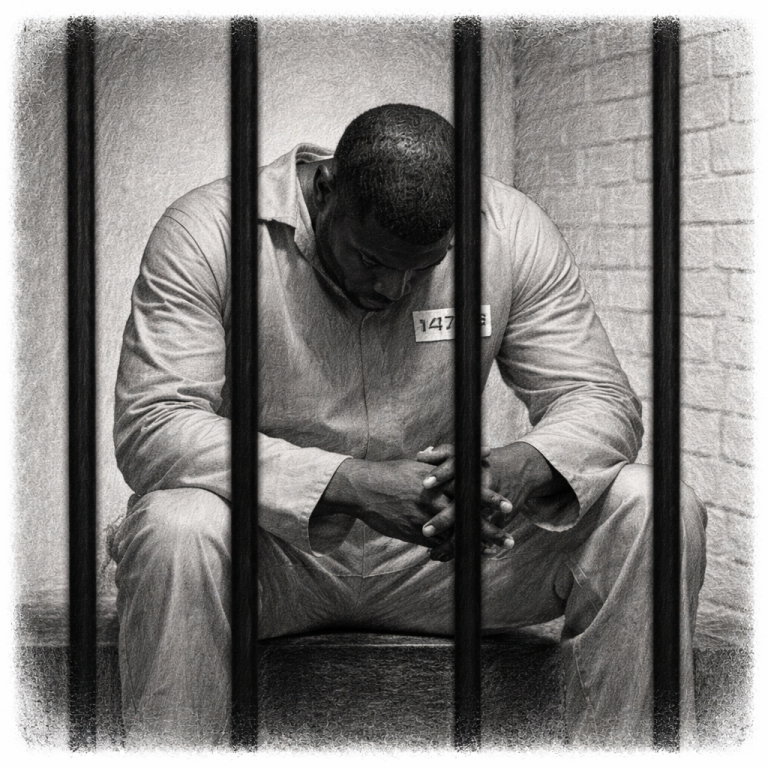
If someone has been redeemed from captivity, he is no longer in chains or imprisoned but has been set free. There is a great difference between being allowed to walk in the prison yard and leaving the prison forever. If someone has been delivered from a harmful habit such as smoking, we do not mean that he smokes less often, but that he is completely free and no longer smokes a single cigarette. Likewise, if someone has been redeemed from sin, he is free from sin. He does not sin less or less frequently, but, thanks be to God, he is entirely free. This is the very heart of the Gospel. "For in that he died, he died unto sin once: but in that he liveth, he liveth unto God. Likewise reckon ye also yourselves to be dead indeed unto sin, but alive unto God through Jesus Christ our Lord" (Rom. 6:10-11).
When the Jews were speaking with Jesus, He said, "If ye continue in my word, then are ye my disciples indeed; and ye shall know the truth, and the truth shall make you free" (John 8:31-32). They thought He was speaking of earthly bondage and did not understand Him. Therefore they answered, "We be Abraham's seed, and were never in bondage to any man" (v. 33). Jesus explained, "Whosoever committeth sin is the servant of sin... If the Son therefore shall make you free, ye shall be free indeed" (John 8:34-36). Therefore, whoever sins cannot be a brother of Jesus (cf. Matt. 12:50) and cannot remain in the house of God. He is a servant of sin, a servant of the devil, because "He that committeth sin is of the devil" (I John 3:8). But if we do not transgress His commandments, we remain at peace with God and continue as His children. "In this the children of God are manifest, and the children of the devil" (1 John 3:10).
Can a Sinner Enter Heaven?
1. Heaven Is a Place of Reward
The Scriptures tell us that after death a crown of righteousness awaits the righteous (cf. II Tim. 4:8), and that they shall enter the place which Jesus has prepared for them (cf. John 14:2). Jesus comforted His disciples by speaking of a treasure in heaven (cf. Matt. 19:21), and in Rev. 14:13 we are given this promise: "Blessed are the dead which die in the Lord from henceforth: Yea, saith the Spirit, that they may rest from their labours; and their works do follow them." Thus heaven is a place of reward, where God—the source of all that is good—reigns.
2. Who Is Fit for Heaven?
There is hardly any need to prove that God cannot permit sinners, the disobedient, criminals, the unclean, and the like to dwell in His holy presence. Anyone who is familiar with both history and the Scriptures does not question the holiness of Jesus. Furthermore, the Scriptures tell us that God expects us "to be conformed to the image of his Son, that he might be the firstborn among many brethren" (cf. Rom. 8:29). It is His desire that Jesus should not be alone in heaven, but that many brethren, made like unto Him, should be there with Him. This likeness refers above all to the innocence and holiness of Jesus (cf. I Pet. 2:22).
For this reason Paul labored, "...that he might present it to himself a glorious church, not having spot, or wrinkle, or any such thing; but that it should be holy and without blemish" (Eph. 5:27). Without this purity it is impossible to enter into God's holy presence. Sin is like a wall that separates us from God. "Your iniquities have separated between you and your God, and your sins have hid his face from you" (Isa. 59:2). Therefore, no sinner can come into the presence of God.
The Apostle John compares the church of the redeemed to a city and to a bride: "And I John saw the holy city, new Jerusalem, coming down from God out of heaven, prepared as a bride adorned for her husband" (Rev. 21:2). A few verses later he speaks of its purity: "And there shall in no wise enter into it any thing that defileth, neither whatsoever worketh abomination, or maketh a lie: but they which are written in the Lamb's book of life" (Rev. 21:27).
The Apostle Paul also gives this solemn warning: "Know ye not that the unrighteous shall not inherit the kingdom of God? Be not deceived: neither fornicators, nor idolaters, nor adulterers, nor effeminate, nor abusers of themselves with mankind, nor thieves, nor covetous, nor drunkards, nor revilers, nor extortioners, shall inherit the kingdom of God" (I Cor. 6:9-10).
Because God is holy and permits nothing unclean in His presence, only those who have been justified through the blood of Jesus shall enter heaven. Some ask why God does not already separate the good from the evil visibly here upon the earth. In the parable of the wheat and the tares (Matt. 13:24-30; 36-42), Jesus explains that the servants were to let the wheat and the tares grow together, "lest while ye gather up the tares, ye root up also the wheat with them." Thus God allows good and evil to grow together among mankind, just as they do in a field, until the day of judgment, when He Himself will separate them.
3. God's Saving Plan
On that great day of judgment every person shall be judged by Jesus Christ. At that time there will no longer be an opportunity to receive pardon, but every one shall receive the righteous reward for his life. No one will escape that judgment, nor will anyone be able to excuse himself. The day of judgment will be without mercy. Therefore, if we desire the gate of heaven to be opened unto us, we must already now stand pure and holy before God.
One very important truth must be clearly understood: nowhere does the Bible teach that death is a redeemer. Solomon compares man's condition after death to a fallen tree: "...if the tree fall toward the south, or toward the north, in the place where the tree falleth, there it shall be" (Eccl. 11:3). Heb. 9:27 declares, "And as it is appointed unto men once to die, but after this the judgment." After death there is no further opportunity for change. After death comes the judgment. Nowhere in the Scriptures do we find any mention of a so-called purgatory or of any place or period in which a person could make amends after death for what he neglected to do, or failed to leave undone, toward God or his fellow man during his lifetime. Such false doctrines are a device of Satan, designed to persuade people that there will still be time later, until at last it is too late. Peace with God must be found today. The Holy Spirit says, "To day if ye will hear his voice, harden not your hearts" (Heb. 3:7-8). We must be justified during this life and already now have peace with God. Paul speaks in the present tense: "Therefore being justified by faith, we have peace with God through our Lord Jesus Christ" (Rom. 5:1).
And it was for this very purpose that Christ came into the world! He does not give us the white robe of righteousness so that we may defile it again the very next day. Peter uses a vivid illustration for those who do such things: "The dog is turned to his own vomit again; and the sow that was washed to her wallowing in the mire" (II Pet. 2:22). In Tit. 2:11-12 the Apostle Paul explains the purpose of salvation in these words: "For the grace of God that bringeth salvation hath appeared to all men, teaching us that, denying ungodliness and worldly lusts, we should live soberly, righteously, and godly, in this present world." We are to be saved from sin, not to return again to the works of unrighteousness.
4. Self-Deception Is Foolish and Profitless
In order to live a godly life, one must overcome selfish desires. Our own lusts must be denied. "For the flesh lusteth against the Spirit, and the Spirit against the flesh: and these are contrary the one to the other: so that ye cannot do the things that ye would" (Gal. 5:17). It is a spiritual conflict in which we must bring our human nature into subjection to God.
Sadly, only a few are willing to enter into this conflict and take part in overcoming. Most people find it easier to deceive themselves. Paul gave this warning: "For the time will come when they will not endure sound doctrine; but after their own lusts shall they heap to themselves teachers, having itching ears" (II Tim. 4:3). On several occasions I have heard bereaved families at funerals being comforted with the assurance that the deceased has now at last, after a long struggle, entered into the long-awaited peace, rest, and deliverance. Likewise, many so-called Christian books present the comforting thought that after death everything will somehow become better.
In one respect such a promise is indeed true; in another respect it is a subtle deception of the enemy of souls. Certainly, some people have endured great afflictions because of sickness, accidents, or difficult family circumstances. But we are speaking here of those who have ruined their lives through sin. Although they lived in disobedience to God, they are nevertheless promised forgiveness. False teachers present only the first part of Tit. 2:11: "For the grace of God that bringeth salvation hath appeared to all men." The second part of the passage, "denying ungodliness and worldly lusts," is of no importance to them. Consequently, it is claimed that there is nothing a person must do, because Jesus has done everything for us. In this way souls are lulled into a careless and passive expectation, believing that nothing needs to be changed and yet heaven will still be theirs. According to these helpers of Satan, we possess, so to speak, a free ticket to heaven because "all have sinned, and come short of the glory of God; being justified freely by his grace through the redemption that is in Christ Jesus" (Rom. 3:23-24). What unbelief in the power and the righteousness of God!
We must not only be saved through faith, but also continue to walk in that pure and undefiled condition. Our salvation from sin is a gift of God. By it God has made it possible for us to come into His presence and have fellowship with Him. It is not His purpose that we should lose this privilege again after a short time through sin. Therefore, together with Paul, let us exhort all believers: "...by the mercies of God, that ye present your bodies a living sacrifice, holy, acceptable unto God, which is your reasonable service. And be not conformed to this world: but be ye transformed by the renewing of your mind, that ye may prove what is that good, and acceptable, and perfect, will of God" (Rom. 12:1-2; cf. Matt. 5:8; Eph. 2:1-10).
Let us therefore be diligent and not neglect so great a salvation.
Temptation and Sin
Many people who call themselves Christians sincerely believe that it is impossible to live without sin. They consider themselves to have an irrefutable argument. Even if one could remain pure in every other respect, they say, it is impossible to do so in one's thoughts. Experience has taught them that, despite every sincere effort to live in a manner pleasing to God, sinful thoughts still arise in the mind. Even the commandment from the Ten Commandments, "Thou shalt not covet thy neighbour's house, thou shalt not covet thy neighbour's wife, nor his manservant, nor his maidservant, nor his ox, nor his ass, nor any thing that is thy neighbour's" (Exod. 20:17), appears impossible to keep. Who has never experienced a thought of envy? Likewise, many suppose that it is impossible for a man to look upon an attractive woman without feeling desire (cf. Matt. 5:28). Consequently, every thought of this kind is regarded as sin.
Yet the Scriptures also speak of temptation. "Watch and pray, that ye enter not into temptation" (Matt. 26:41). How does one enter into temptation? How is temptation to be distinguished from sin? If every impure thought were already sin, what room would remain for temptation? Yet we know that temptation exists and that every one of us may be tempted. Even of Jesus it is written that He "was in all points tempted like as we are, yet without sin" (Heb. 4:15).
The attentive reader of the Scriptures recognizes that there is a difference between making a mistake, being tempted, and committing sin. These three things must be carefully distinguished. Only when we follow God's Word exactly, neither taking away from it nor adding to it, can we have the proper zeal concerning sin and live a life that is pleasing to God. Just as removing anything from God's Word brings His judgment, so adding to it also brings His warning (cf. Rev. 22:18-19). Therefore, let us neither minimize sin nor classify as sin what the Scriptures do not call sin.
The Epistle of James gives us further light on this subject. Let us carefully consider these verses: "But every man is tempted, when he is drawn away of his own lust, and enticed. Then when lust hath conceived, it bringeth forth sin: and sin, when it is finished, bringeth forth death" (James 1:14-15). Notice that sin appears only after lust has conceived. The thought itself is not yet described as sin; rather, temptation becomes sin when lust is embraced and allowed to conceive.
Let me illustrate this with a simple example. An impure thought comes into the mind. Instead of rejecting it immediately, a person begins to dwell upon it and to entertain it, although the Scriptures warn against doing so. If the thought is not firmly resisted, it gradually gains a deeper hold until the person finally decides to commit the forbidden act.
The same principle applies to theft. At first a person notices an object and begins to desire it. The desire grows stronger until he wants to possess it, but does not yet know how. Then the thought of stealing it arises, perhaps still accompanied by fear and reluctance. If he does not put that desire to death but instead yields to it, there comes a moment when he decides to steal it. Here lies the decisive point: lust has conceived. The will has consented, the decision has been made, and only the opportunity to carry it out remains. What began as temptation has now become sin. The sin has already been committed in the heart.
We cannot prevent an evil thought from presenting itself to our minds, but we are under no obligation to receive it. It is like a merchant knocking at the door, offering his merchandise. We cannot prevent him from knocking, but we certainly do not have to invite him into our house, examine his goods, or purchase them.
Although this sounds simple, some temptations are overcome only through earnest struggle. Yet through sincere prayer and faith the victory can be won. In order to help us in this conflict, God has made full provision. He has sent us the Comforter—the Holy Spirit, our divine Helper—whom we receive through faith as we walk in sanctification.
Scriptures That Seem to Contradict the Possibility of Living Without Sin
1st Scripture: Ps. 14:1; Rom. 3:10-12 — "There is none that doeth good..." (See also Mark 10:18.)
As proof that all people are supposedly sinners and therefore cannot live without sin, Rom. 3:10-12 is often quoted: "There is none righteous, no, not one: There is none that understandeth, there is none that seeketh after God. They are all gone out of the way, they are together become unprofitable; there is none that doeth good, no, not one."
It is claimed that this passage proves that we are all regarded as sinners and that no one "doeth good." However, even a careful consideration of the context shows that Paul is not speaking here of those who have been justified through the atoning blood of Jesus Christ. In the preceding verse he declares, "For we have before proved both Jews and Gentiles, that they are all under sin" (Rom. 3:9). His meaning is that no one is born pure; every person is born in sin (cf. Ps. 51:5), and every human being stands in need of redemption.
The verses that follow contain descriptions that clearly apply to sinners: "Their throat is an open sepulchre; with their tongues they have used deceit." "The poison of asps is under their lips." "Whose mouth is full of cursing and bitterness." "Their feet are swift to shed blood" (vv. 13-15). Furthermore, when we examine the quotation that Paul takes from Ps. 14, we find that it unmistakably describes the ungodly: "The fool hath said in his heart, There is no God." Thus, even a careful examination of the immediate context makes it evident that this passage is not speaking of Christians or of the children of God.
Another passage closely related in meaning to Rom. 3:10-12 is also frequently quoted. It is the statement of Jesus in Mark 10:18: "...There is none good but one, that is, God." Yet Jesus is not saying that a person can never become good, for elsewhere He Himself speaks of a "good man": "A good man out of the good treasure of the heart bringeth forth good things..." (Matt. 12:35).
With the words, "There is none good but one," Jesus points to the source of all goodness. By his own strength, man can never be good. He becomes good only when God has come to dwell in his heart. This may sound strange to some, but it is impossible to do what is truly good while living in enmity against God. Because God views all things in the light of eternity, not every act of human kindness is regarded by Him as truly good. God's definition of what is good differs greatly from man's. "A good tree cannot bring forth evil fruit, neither can a corrupt tree bring forth good fruit" (Matt. 7:18).
To explain this thought fully and support it with additional Scriptures would go beyond the scope of this article. It requires careful Bible study. Paul writes: "And such trust have we through Christ to God-ward: Not that we are sufficient of ourselves to think any thing as of ourselves; but our sufficiency is of God; Who also hath made us able ministers of the new testament..." (II Cor. 3:4-6).
Therefore, a person can indeed become good—but not of himself. He becomes good when he receives into his heart Him who alone is good, namely God. This may be compared to the moon. It has no light of its own; yet, by reflecting the light of the sun, it illuminates the traveler's path through the darkness of night. In the same way, God comes into our hearts and makes them good. This is exactly what we read in John 14:23: "If a man love me, he will keep my words: and my Father will love him, and we will come unto him, and make our abode with him." Likewise, I Cor. 3:16 says: "Know ye not that ye are the temple of God, and that the Spirit of God dwelleth in you?"
One more important point should be mentioned, though we can only touch upon it briefly because of the scope of this article. In order to preserve the good within his heart, man needs divine help. In the spiritual conflict he must be endued with the Holy Spirit. Jesus knew this and therefore commanded His disciples: "...But tarry ye in the city of Jerusalem, until ye be endued with power from on high" (Luke 24:49). Without this power, we too would have to cry out with Paul, as he did while still under the Law: "For the good that I would I do not: but the evil which I would not, that I do" (Rom. 7:19)
2nd Scripture: I John 1:8 — "If we say that we have no sin, we deceive ourselves, and the truth is not in us."
This passage appears to provide clear proof that sin remains with us throughout our entire lifetime. Yet here again the Scriptures do not contradict themselves. We simply need to observe the line of thought that runs like a thread throughout this epistle. For what purpose, and to whom, did the Apostle John write this letter? Its principal thoughts are even repeated several times. We notice that themes such as love, a steadfast walk, the assurance of salvation, and Jesus Christ occur again and again. It should also be noted that, at that time, there was an ongoing spiritual conflict with those among the Jews who professed to believe in God but rejected Jesus. They considered themselves righteous and refused the necessity of repentance (cf. Luke 7:30).
One cannot fail to notice the emphasis with which the Apostle John points to Jesus Christ. Read the first chapter carefully. The seventh verse may well be regarded as the central thought of the chapter: "But if we walk in the light, as he is in the light, we have fellowship one with another, and the blood of Jesus Christ his Son cleanseth us from all sin." In order to emphasize the necessity of accepting this atoning sacrifice, he adds: "If we say that we have no sin, we deceive ourselves, and the truth is not in us" (v. 8). In verse 9 he repeats and confirms the truth expressed in verse 7 concerning cleansing through the blood of Jesus, and verse 10 repeats the thought of verse 8: "If we say that we have not sinned..." Here it should be observed that he does not say, "if we do not sin" (present tense), but "have not sinned," referring to the past. And all of us have sinned. The Word of God declares: "Wherefore, as by one man sin entered into the world, and death by sin; and so death passed upon all men, for that all have sinned" (Rom. 5:12). Therefore, all people need His grace; yet this was precisely what the self-righteous Jews rejected. Immediately afterward the Apostle writes, "My little children, these things write I unto you, that ye sin not" (I John 2:1). Later he repeats the same truth in different words: "Whosoever abideth in him sinneth not" (chap. 3:6); "He that committeth sin is of the devil" (v. 8); "Whosoever is born of God doth not commit sin" (v. 9). Throughout the entire epistle only one exceptional case is mentioned: "...and if any man sin, we have an advocate with the Father, Jesus Christ the righteous" (chap. 2:1). The words "and if" indicate that this is not the normal condition of the Christian life, but an exception.
If we believe that the Apostle John wrote a thoughtful and coherent epistle and did not grossly contradict himself, then his teaching concerning sin may be summarized as follows:
- All people have sinned and stand in need of the mercy of God.
- After they have been cleansed through the blood of Jesus, they remain in fellowship with God and do not continue in sin.
- As an exceptional case—if someone should fall into sin—they have an Advocate, Jesus Christ, with the Father. They may seek forgiveness and be restored to their normal condition of a life free from sin.
3rd Scripture: Rom. 7:15 — "...for what I would, that do I not; but what I hate, that do I."
This statement is written in the present tense. Therefore, many naturally interpret it to mean that it is impossible to live without sin because man is too weak. As with all other passages of Scripture that appear to present a contradiction, we must also consider the context—in this case, the entire epistle. To follow Paul's line of thought verse by verse and comment on it would require several pages of explanation. Therefore, I shall limit myself to the most important points and ask the reader to examine these arguments carefully in the light of the Scriptures and their context.
After explaining in chapter 5 the origin of sin and redemption through faith, Paul speaks in chapter 6 of a life free from sin. He compares it with baptism, with death, with being "free," and with being a "servant." His meaning is unmistakable: the believer is not to continue in sin. Consider just a few of the passages that support this truth: "...we, that are dead to sin..." (v. 2); "...that henceforth we should not serve sin" (v. 6); "Likewise reckon ye also yourselves to be dead indeed unto sin, but alive unto God through Jesus Christ our Lord" (v. 11); "For sin shall not have dominion over you..." (v. 14). Likewise, in chapter 8 Paul takes exactly the same position toward sin as he does in chapter 6, saying: "For the law of the Spirit of life in Christ Jesus hath made me free from the law of sin and death" (Rom. 8:2).
Could it be that Paul contradicts himself in chapter 7?
To arrive at the proper interpretation, let us follow the course of thought in chapter 7. At the beginning Paul compares the Law to the binding relationship of marriage. He then raises the question of the Law's purpose, only to explain shortly afterward its necessity in connection with our fleshly nature. In verse 11 he is still writing in the past tense: "For sin, taking occasion by the commandment, deceived me, and by it slew me." Here we come to an important point. Beginning with verse 12, Paul changes, almost unnoticed, to the present tense: "Wherefore the law is holy..." The use of the present tense is necessary because he wishes to describe more vividly the condition of the human heart apart from the redemption that is in Jesus Christ. Verse 15 says: "For that which I do I allow not: for what I would, that do I not; but what I hate, that do I." By this Paul demonstrates that the Law is spiritual, whereas we are carnal, sold under sin (cf. v. 14). He continues in the present tense throughout the following verses as he describes the condition of a person under the Law, until finally, in verse 24, he must cry out: "O wretched man that I am! who shall deliver me from the body of this death?"
Here the turning point is reached. Paul now points to the way of deliverance and salvation: "I thank God through Jesus Christ our Lord." He concludes: "So then with the mind I myself serve the law of God; but with the flesh the law of sin." It now becomes evident that the mind of the flesh and the mind of the Spirit are opposed to one another, and that under the Law it is impossible to overcome the fleshly mind. But thanks be to God! "For what the law could not do, in that it was weak through the flesh, God sending his own Son in the likeness of sinful flesh, and for sin, condemned sin in the flesh" (Rom. 8:3). We do not obtain redemption through our own efforts or works; it is the work of God. We owe it to the grace of God that we are no longer servants of sin but servants of Him. We have this promise: "But if the Spirit of him that raised up Jesus from the dead dwell in you, he that raised up Christ from the dead shall also quicken your mortal bodies by his Spirit that dwelleth in you" (Rom. 8:11).
4th Scripture: I Tim. 1:15 — "This is a faithful saying, and worthy of all acceptation, that Christ Jesus came into the world to save sinners; of whom I am chief."
Some interpret this passage to mean that if the Apostle Paul was the "chief" of sinners, then it is even less possible for us to live without sin. Let us, however, consider the verses that immediately precede it: "And I thank Christ Jesus our Lord, who hath enabled me, for that he counted me faithful, putting me into the ministry; who was before a blasphemer, and a persecutor, and injurious: but I obtained mercy, because I did it ignorantly in unbelief..." (vv. 12-13).
We remember that Paul's former life was by no means friendly toward Jesus, and that he had no reason to expect any special favor from Him. Even in regard to time, the other apostles had received grace long before he did. Speaking of himself, he says, "...and last of all he was seen of me also, as of one born out of due time" (I Cor. 15:8). Paul never forgot his past, and he uses expressions here that reveal his humility. Yet he also had reason to glory. Before the Corinthians he was compelled to defend himself and was forced to recount his labors: "Are they Hebrews? so am I. Are they Israelites? so am I. Are they the seed of Abraham? so am I. Are they ministers of Christ? (I speak as a fool) I am more; in labours more abundant, in stripes above measure, in prisons more frequent, in deaths oft" (II Cor. 11:22-23). The list continues in the following verses. And in I Cor. 15:10 he openly declares: "...I laboured more abundantly than they all: yet not I, but the grace of God which was with me."
Surely he could also have spoken of many other privileges: "For though I would desire to glory, I shall not be a fool; for I will say the truth: but now I forbear, lest any man should think of me above that which he seeth me to be, or that he heareth of me. And lest I should be exalted above measure through the abundance of the revelations..." (II Cor. 12:6-7). But God preserved him in humility. He remained deeply conscious of his former evil deeds, that he had been "a blasphemer, and a persecutor, and injurious" (I Tim. 1:13). Likewise, in I Cor. 15:9 he writes: "For I am the least of the apostles, that am not meet to be called an apostle, because I persecuted the church of God." Because he had persecuted the church, he considered himself unworthy of being called anything greater than "the least."
We therefore conclude that, by the expression "chief" in I Tim. 1:15, Paul does not mean that he remained a sinner. Rather, he continues in verse 16: "Howbeit for this cause I obtained mercy, that in me first Jesus Christ might shew forth all longsuffering, for a pattern to them which should hereafter believe on him to life everlasting." It is evident that Paul desires to give hope to those who, like himself, had once fallen deeply into sin and considered themselves unworthy of the grace of God.
There is yet another point that would otherwise be entirely contradictory. In one place he would be describing himself as the chief of sinners, while elsewhere he writes: "Ye are witnesses, and God also, how holily and justly and unblameably we behaved ourselves among you that believe" (I Thess. 2:10).
5th Scripture: James 4:17 — "Therefore to him that knoweth to do good, and doeth it not, to him it is sin."
"Have you succeeded up to this very day in doing all the good that you know you ought to do? If you think of every opportunity you have had to do good, you will discover that you have not had enough time to do it all. You see, then neither can you live without sin!"
I have been answered in this way, or in similar words, more than once. If one insists upon a merely literal interpretation of the text, such arguments may appear convincing. But let us judge the matter honestly. Has a loving father ever given his child a task that he knew the child was unable to accomplish? Does not such an interpretation also imply that God, our heavenly Father, places unjust demands upon us? Is God more severe than our earthly fathers? It seems that some would rather regard this commandment as impossible to fulfill so that they may set it aside altogether. Then they may say, like the slothful servant, "Lord, I knew thee that thou art an hard man..." (Matt. 25:24).
Both sound reason and our own conscience testify that God requires of us only those things that we are able to do. The parable mentioned above clearly shows that the master did not give the same number of talents to every servant. He created us, and He knows our abilities. To whom much has been given, of him much shall be required. Even to the servant who had received only one talent, the master said, "Thou oughtest therefore to have put my money to the exchangers, and then at my coming I should have received mine own with usury" (Matt. 25:27).
Everyone is able to do good. If we have been diligent in doing the good that lay within our reach, we may have confidence that God will say to us, "Come, ye blessed of my Father..." (Matt. 25:34). But if we see someone in need and shut up our compassion from him instead of helping him, as described in I John 3:17, would this not rightly be counted to us as sin? God does not require us to stand at the foot of a mountain and assist every climber. Rather, like the good Samaritan, we are to help those whom we meet in need. Sin, therefore, also includes knowingly neglecting the good that we are able to do, or withholding the help that lies within our power (cf. Luke 10:30-32).
Conclusion
I have met Christians who seem to regard every mistake and every temptation as sin. Nevertheless, they earnestly strive to please God and to live blameless before Him. Will God reject them because they have not yet come to a proper understanding of sin? I do not believe so. God "will render to every man according to his deeds: To them who by patient continuance in well doing seek for glory and honour and immortality, eternal life: But unto them that are contentious, and do not obey the truth, but obey unrighteousness, indignation and wrath, Tribulation and anguish, upon every soul of man that doeth evil..." (Rom. 2:6-9). Is it, then, merely a matter of interpretation, so that it makes no real difference? Certainly not.
If we accept the interpretation that it is impossible to live without sin, we must also admit that we are continual failures. We struggle and strive, yet in vain—we are unable to resist sin. We would have to acknowledge that Satan has gained the victory over us. In that case Christ has not truly delivered us. "He that committeth sin is of the devil; for the devil sinneth from the beginning. For this purpose the Son of God was manifested, that he might destroy the works of the devil" (I John 3:8).
Every form of bondage is oppressive to human nature, and life under the yoke of sin is no exception. When Jesus was born, the angel said unto the shepherds, "Behold, I bring you good tidings of great joy... For unto you is born this day... a Saviour" (Luke 2:10-11). That Saviour did not come to deliver the Jewish people from the bondage of the Romans, but from the bondage of sin. Many other passages of Scripture proclaim this Gospel—the Good News—for souls afflicted by sin. True liberty gives us confidence that our service is acceptable unto God. It gives us assurance that our prayers are heard. It fills our walk with joy, and that joy becomes a driving force in the life of a Christian. Without true liberty and without joy, Christianity loses its attractiveness and is no longer worthy of imitation. Thus, a false interpretation places Christians in a position where they cannot enjoy continual joy, cannot be certain of God's presence, and remain defeated in the conflict of faith.
Jesus came into the world to bring the joy of salvation! If we walk according to the law of the Spirit (cf. Rom. 8:2); if we preserve our spirit, soul, and body blameless (cf. I Thess. 5:23); if we are crucified unto the world and keep our body under subjection (I Cor. 9:27; Gal. 6:14), then we are victorious. We may say with the Apostle Paul, "Now thanks be unto God, which always causeth us to triumph in Christ..." (II Cor. 2:14). Thanks be to God! When rightly understood, the Bible shines forth with the message of salvation and joy. We are no longer enemies and losers, but children of God. "And if children, then heirs; heirs of God, and joint-heirs with Christ; if so be that we suffer with him, that we may be also glorified together" (Rom. 8:17).