The "Thousand-Year Reign" — Illusion and Truth
It is probably impossible to determine with certainty when the idea of a thousand-year reign first arose. What is certain, however, is that in times of distress and oppression the Jewish people longed for lasting peace and for a flourishing and powerful kingdom, similar to that of Solomon's reign. In view of the hopeful prophecies, they may well have envisioned a thousand-year kingdom of peace.
You can find the original text in German here...
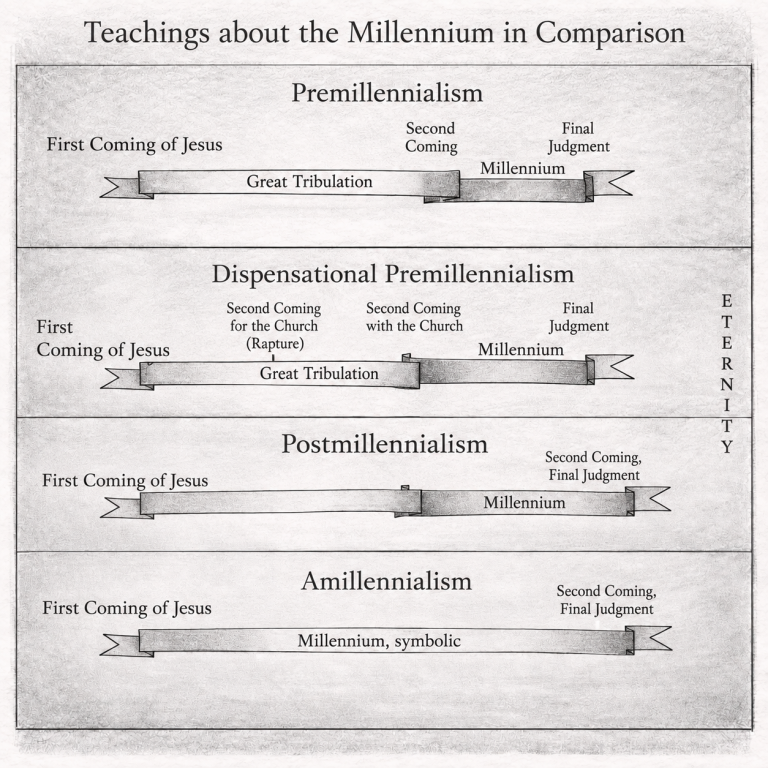
When the Book of Revelation was written and people read the words, "...they shall reign with him a thousand years" (Rev. 20:6), they were no doubt stirred by the hope of a paradise upon earth. The purpose of this article, however, is to demonstrate from the Scriptures that this passage is not speaking of political dominion upon this earth, nor of earthly prosperity, but rather of spiritual realities that are to come upon the believers.
In order to interpret Rev. 20:1-7 correctly, several boldfaced terms will first be explained. The underlined passages will be discussed in the central exposition.
Chapter 1 — The Original Text of Revelation 20:1-7 Followed by an Explanation of the Method of Interpretation
1. And I saw an angel come down from heaven, having the key of the bottomless pit and a great chain in his hand.
2. And he laid hold on the dragon, that old serpent, which is the Devil, and Satan (explained in section 3.2), and bound him a thousand years (section 3.1),
3. And cast him into the bottomless pit, and shut him up, and set a seal upon him, that he should deceive the nations no more, till the thousand years should be fulfilled: and after that he must be loosed a little season.
4. And I saw thrones, and they sat upon them, and judgment was given unto them: and I saw the souls of them that were beheaded for the witness of Jesus, and for the word of God, and which had not worshipped the beast, nor his image (section 3.3), neither had received his mark upon their foreheads, or in their hands (section 3.4); and they lived (section 3.5) and reigned with Christ a thousand years.
5. But the rest of the dead lived not again until the thousand years were finished. This is the first resurrection (section 3.5).
6. Blessed and holy is he that hath part in the first resurrection: on such the second death (section 3.5) hath no power, but they shall be priests of God and of Christ, and shall reign with him a thousand years.
7. And when the thousand years are expired, Satan shall be loosed out of his prison.
(Rev. 20:1-7, adapted from the Elberfelder Translation.)
The structure of this study is outlined by the following headings.
In Chapter 2, the necessary foundations are established:
2.1 Under What Circumstances and in What Manner Will Jesus Return?
Since the Thousand-Year Reign is closely connected by most interpreters with the return of Christ, this question must first be answered.
2.2 Necessary Principles for Interpreting Prophetic Terms
The meaning of prophetic expressions must first be established before they can be interpreted correctly.
Because the Thousand-Year Reign of Rev. 20 is commonly interpreted together with passages from the prophetic books, we must also examine:
2.3 The "Kingdom of Peace" in Isaiah 65:17-25
Chapter 3 serves as preparation for the exposition in Chapter 4. The boldfaced expressions occurring in this passage are explained beforehand.
3.1 Must the Thousand Years Be Exactly One Thousand Years?
3.2 What Do the Symbols "Dragon," "Serpent," "Devil," and "Satan" Mean?
3.3 What Do the Symbols "the Beast" and "His Image" Mean?
3.4 What Is Meant by "the Mark upon Their Foreheads and upon Their Hands"?
3.5 What Is Meant by the "First" and the "Second" Resurrection?
After these preparations, we shall examine Revelation 20:1-7 verse by verse in:
4. Exposition of Revelation 20:1-7
Finally, the study concludes with:
5. Concluding Remarks
To ensure that the interpretations presented here are not arbitrary but rest upon a solid biblical foundation, the reasons for particular interpretations will be explained throughout the study. In order to keep the presentation clear and concise, this article has been written in a condensed form, emphasizing the fundamental principles of interpretation.
In addition, every reader should personally study the biblical context of these subjects through a life consecrated to God, through prayer, and through diligent searching of the Holy Scriptures, so that a complete understanding may be gained. Why these prerequisites are essential is explained in the article "Understanding the Bible" on this website. Only then, with God's help, is a clear understanding of this subject possible.
Since it would go beyond the scope of this article to explain the structure of God's spiritual Kingdom, the reader is referred to another important article on this website: "The Kingdom of God"
Chapter 2 — Prerequisites
2.1 Under What Circumstances and in What Manner Will Jesus Return?
On an Ordinary Day and Unexpectedly
"Likewise also as it was in the days of Lot; they did eat, they drank, they bought, they sold, they planted, they builded; But the same day that Lot went out of Sodom it rained fire and brimstone from heaven, and destroyed them all. Even thus shall it be in the day when the Son of man is revealed" (Luke 17:28-30). "But the day of the Lord will come as a thief in the night; in the which the heavens shall pass away with a great noise, and the elements shall melt with fervent heat, the earth also and the works that are therein shall be burned up" (II Pet. 3:10). "...for as the lightning cometh out of the east, and shineth even unto the west; so shall also the coming of the Son of man be" (Matt. 24:27).
These Scriptures clearly show that the Lord will come unexpectedly and on an entirely ordinary day. There is not a single indication that a kingdom will be established on the day of His coming. Peter declares that the earth will "pass away." His coming will not be secret, but visible to all: "This same Jesus, which is taken up from you into heaven, shall so come in like manner as ye have seen him go into heaven" (Acts 1:11).
It should first be noted that there is no contradiction in Jesus' return occurring at both daytime and nighttime simultaneously. Since the earth is round, day and night exist at the same time in different parts of the world. Jesus said, "I tell you, in that night there shall be two men in one bed; the one shall be taken, and the other shall be left. Two women shall be grinding together; the one shall be taken, and the other left. Two men shall be in the field; the one shall be taken, and the other left" (Luke 17:34-36). By the words "taken" and "left," Jesus describes the immediate separation of the righteous from the wicked. Not every detail of His return has been revealed to us, but one thing is certain: there will not be an interval of a thousand years between the resurrection of the righteous and that of the wicked.
There Will Not Be Separate Resurrections for Believers and the Wicked
At the same moment—not separated by time, as some interpretations suggest — the believers who are still alive will be changed in order to appear before the Lord together with those who have fallen asleep in Christ: "Behold, I shew you a mystery; We shall not all sleep, but we shall all be changed, In a moment, in the twinkling of an eye, at the last trump: for the trumpet shall sound, and the dead shall be raised incorruptible, and we shall be changed. For this corruptible must put on incorruption, and this mortal must put on immortality" (I Cor. 15:51-53).
In Scripture it is common that, when describing an event, not every group involved is mentioned, but only those who are directly relevant to the immediate context. For example, in Jude 6, in connection with the judgment, only the fallen angels are mentioned: "And the angels which kept not their first estate, but left their own habitation, he hath reserved in everlasting chains under darkness unto the judgment of the great day."
In I Thess. 4:13-18 the Apostle Paul comforts the believers by speaking of the resurrection. There he mentions only the believers who have fallen asleep: "...the dead in Christ shall rise first." The wicked, who likewise will be raised or changed, are simply not mentioned in that passage (cf. Matt. 24:31). Elsewhere the Apostle Peter speaks exclusively of the wicked: "But the heavens and the earth, which are now, by the same word are kept in store, reserved unto fire against the day of judgment and perdition of ungodly men" (II Pet. 3:7). The words of Jesus plainly confirm the resurrection of all the dead: "Marvel not at this: for the hour is coming, in the which all that are in the graves shall hear his voice, And shall come forth; they that have done good, unto the resurrection of life; and they that have done evil, unto the resurrection of damnation" (John 5:28-29; cf. Matt. 13:41-43; Matt. 25:31-32).
The Bible therefore speaks clearly of one simultaneous resurrection of the dead and the transformation of the living at the return of Christ: "For this we say unto you by the word of the Lord, that we which are alive and remain unto the coming of the Lord shall not prevent them which are asleep. For the Lord himself shall descend from heaven with a shout, with the voice of the archangel, and with the trump of God: and the dead in Christ shall rise first: Then we which are alive and remain shall be caught up together with them in the clouds, to meet the Lord in the air: and so shall we ever be with the Lord" (I Thess. 4:15-17).
Jesus Will Not Come a Third Time
"...so Christ was once offered to bear the sins of many; and unto them that look for him shall he appear the second time without sin unto salvation" (Heb. 9:28). Whether we consider this or any other passage of Scripture, nowhere is there any mention of a third coming of Christ. Even after His ascension, the angels testified only of one future return: "This same Jesus, which is taken up from you into heaven, shall so come in like manner as ye have seen him go into heaven" (Acts 1:11).
A Brief Summary of the Return of Christ
- At His coming, "all that are in the graves" shall be raised (John 5:28).
- "Then we which are alive and remain shall be caught up together with them" (I Thess. 4:17; cf. I Cor. 15:51-53).
- After the return of Christ, the judgment will take place (cf. John 5:28-29; Matt. 13:41-43; Matt. 25:31-32).
Conclusion: The resurrection will take place simultaneously for all. Therefore, there is no chronological possibility for a thousand-year reign either before or after Christ's judgment. At the return of Christ, the earth will pass away, and the final judgment will take place. There will not be a third coming of Christ.
2.2 Fundamental Principles for Interpreting Prophetic Terms
In many interpretations of the subject of the Thousand-Year Reign, it becomes evident that misunderstandings often arise because different biblical statements are combined arbitrarily. The reader frequently does not even notice that individual passages of Scripture have been taken out of their context and thereby given a meaning different from the one originally intended.
It requires much time and patience to examine every argument carefully in order to determine whether the cited Scripture truly supports the interpretation being presented. Therefore, the fundamental principle of prophetic interpretation will first be explained and illustrated by several examples.
Let us take as an example the parable of the sower, which Jesus Himself explains: "The sower soweth the word. And these are they by the way side, where the word is sown; but when they have heard, Satan cometh immediately, and taketh away the word that was sown in their hearts. ... And these are they which are sown on good ground; such as hear the word, and receive it, and bring forth fruit, some thirtyfold, some sixty, and some an hundred" (Mark 4:14-15, 20).
People living in industrialized countries today can scarcely imagine how seed was sown by hand in those days. Therefore, the reader of Scripture must take into account the language and cultural background of that time. In this parable, the spoken Word is compared to seed scattered by hand. Some hear it and remain indifferent. Others allow it to change them—their thinking and their whole manner of life are transformed. Thus, the Word of God is like seed: it may be rejected and "die," or it may grow and bear fruit.
Another example is found in the parable of the field in Matthew 13, where Jesus explains: "...the field is the world; the good seed are the children of the kingdom; but the tares are the children of the wicked one" (Matt. 13:38). In this way we learn how to understand correctly the figurative language and symbolism of the parables.
Isa. 30:26 declares that the light of the sun "shall be sevenfold, as the light of seven days." If this verse were interpreted literally, one would have to conclude—as some rather fanciful interpretations do—that the earth would be burned to ashes. Likewise, any attempt to draw Ezekiel's vision of the four living creatures and the wheels (Ezek. 1) exactly as it appears would inevitably result in a bizarre and distorted picture. Unfortunately, many explanations of Scripture attempt to interpret symbolic or spiritual statements in a strictly literal manner. This inevitably leads to contradictions with other biblical teachings and often results in confusing and illogical conclusions.
Conclusion: Many prophetic expressions are not intended to be understood literally. They are often given as comparisons or symbolic illustrations.
2.3 The Kingdom of Peace in Isaiah 65:17-25
The passage in Isa. 65:17-25 is frequently cited in support of a so-called Thousand-Year Reign. Yet this prophecy does not mention the thousand years at all. Instead, it contains figurative comparisons that have led many interpreters to develop highly imaginative concepts. Even a brief reading of the passage reveals that Jerusalem is described as flourishing naturally, while at the same time an extraordinary lifespan is portrayed. God appears near at hand and ready to answer, and the animals serve as symbols of peaceful coexistence. Even a superficial reading makes it evident that the passage is not intended to be understood literally. A lifespan "as the days of a tree" would contradict God's own determination for mankind: "...yet his days shall be an hundred and twenty years" (Gen. 6:3). Likewise, for a lion to eat straw, it would have to possess an entirely different digestive system. Rather than comparing the various interpretations that have been proposed, we shall consider directly the prophetic meaning of this passage.
Isa. 65, verse 17. At the very beginning we read the words, "...I create new heavens and a new earth." If we search the Scriptures for the expression "heavens and earth," we find, for example, II Pet. 3:6-7: "...the world that then was, being overflowed with water, perished: But the heavens and the earth, which are now... are kept in store, reserved unto fire...." Verse 12 declares that they shall "pass away with a great noise" and "be dissolved." Here Peter is clearly speaking of the visible heavens and the physical earth. Yet in verse 13 he continues: "Nevertheless we, according to his promise, look for new heavens and a new earth, wherein dwelleth righteousness." Righteousness, however, can dwell only in a spiritual kingdom—where God's love and holiness live in the hearts of men.
Why does Isaiah speak only of the heavens and the earth, but not of mankind or the animals? Because these two expressions embrace the entire environment in which man lives—everything that shapes his existence. They are the greatest, most important, and constantly visible elements surrounding him. From heaven comes the light by which we find our way. It determines the course of the day. In the atmosphere is the oxygen essential for life. The weather from heaven determines the seasons for sowing and harvest. Upon the earth we walk, cultivate, plant, and build.
In the same way, the spiritual environment is compared to heaven and earth. God, who dwells in heaven, gives us His Word, which—like natural light—provides direction for our spiritual life. Upon this spiritual earth we walk, sow, and reap spiritual fruit.
What, then, are the "new heavens" and the "new earth" of which Isaiah speaks?
We remain on the spiritual level. They represent the New Covenant which God established with mankind through Jesus Christ. Through His coming and the revelation of God's love, He has given us new heavens—new divine standards and heavenly ordinances. The Law of Moses has been fulfilled and has passed away. We no longer need to offer animal sacrifices; they were only a shadow of the perfect sacrifice to come (cf. Col. 2:16-17; Heb. 10:1)—namely, Jesus Christ, who offered Himself once for all (cf. Heb. 7:27). This new heaven now has an eternal High Priest (cf. Heb. 7:18-24).
Through the new commandments which Jesus has given, we have been placed upon a new foundation that governs our conduct (cf. Matt. 5:21-48). Thus we live upon a new earth. Under the New Covenant we are able to sow better spiritual seed and enjoy better spiritual fruit. We have received entirely new privileges, especially:
- free access to the Most Holy Place (cf. Matt. 27:51; Eph. 2:18-19; Heb. 10:19-20);
- the opportunity to be baptized with the Holy Spirit (cf. John 16:7; Acts 2:4; 10:44);
- the power to live without sin (cf. Rom. 6:18; I John 2:1-2);
- a closer fellowship with God (cf. John 4:21-23);
- and the promised spiritual rest (cf. Heb. 4:3-11).
Thus, the prophecy of Isa. 65:17-25 clearly points to the dispensation of grace under the New Covenant.
At this point it is important to establish the connection between Isa. 65:17-25 and Rev. 21:1 through 22:5. In Revelation we are given a similar picture of the beauty of the Church under the New Covenant: "And I saw a new heaven and a new earth: for the first heaven and the first earth were passed away... And I John saw the holy city, new Jerusalem, coming down from God out of heaven, prepared as a bride adorned for her husband" (Rev. 21:1-2). Here again, the new conditions of spiritual life are compared to a new heaven and a new earth. God's chosen people are to be prepared and pure, "as a bride adorned for her husband." The Apostle Paul likewise desired to present the believers in Corinth in this purity: "...for I have espoused you to one husband, that I may present you as a chaste virgin to Christ" (II Cor. 11:2). Compare also the studies on Sonship and Inheritance (Gal. 4:22-31; John 15:15; Rom. 8:17). (Both articles are available in German on this website.) We now return to our consideration of Isa. 65.
Isa. 65:17 continues: "...the former shall not be remembered." The former things refer to the time of the Old Covenant. That they are no longer remembered means that the service of the New Covenant, with all its blessings and joys, far surpasses the old. Therefore, the writer of Hebrews speaks of "a better covenant, which was established upon better promises" (Heb. 8:6). Under the New Covenant we possess "a better hope" (cf. Heb. 7:19), "better sacrifices" (cf. Heb. 9:23), and "a better and an enduring substance" (cf. Heb. 10:34).
Isa. 65:18-19 declares: "...I create Jerusalem a rejoicing, and her people a joy." It was this joy that Jesus brought to mankind. He delivered men from the bondage of sin. We remember how, at the birth of Christ, the shepherds were surprised by the joyful announcement of the angels: "...behold, I bring you good tidings of great joy, which shall be to all people" (Luke 2:10). This was the very first message mankind received concerning the birth of Jesus. Even before His birth, Mary had learned from the angel the reason for this joy: "...thou shalt call his name JESUS: for he shall save his people from their sins" (Matt. 1:21).
But what distinguishes this from the Old Covenant, under which sins were also forgiven? Concerning the forgiveness provided under the Old Covenant, Scripture says that "gifts and sacrifices" were offered "that could not make him that did the service perfect, as pertaining to the conscience" (Heb. 9:9). The sacrifices which Israel was commanded to offer served as types pointing forward to the future sacrifice of Christ, but they could not make men completely free from sin. Through the sacrifices their sins were forgiven, yet they were not able to withstand temptation and therefore sinned again. For that reason, yearly sacrifices were required, in which the high priest obtained forgiveness both for himself and for the people through the shedding of blood.
Christ, however, has "obtained eternal redemption for us" (Heb. 9:12). Now we may finally live with a good conscience, because power has been given to us to live without sin. Thanks be unto God for this Gospel, whose very name means Good News! We are no longer spiritually born again only to sin again shortly afterward and thus die spiritually once more. Isaiah expressed this truth figuratively: "There shall be no more thence an infant of days... for as the days of a tree are the days of my people" (Isa. 65:20-22).
Even Moses proclaimed to Israel the blessing that follows obedience: "If ye walk in my statutes, and keep my commandments, and do them; Then I will give you rain in due season... and the land shall yield her increase, and the trees of the field shall yield their fruit... And ye shall eat your bread to the full, and dwell in your land safely" (Lev. 26:3-5). Those who keep God's commandments under the New Covenant may likewise, according to Isaiah, spiritually "build houses, and inhabit them; and... plant vineyards, and eat the fruit of them" (Isa. 65:21).
Through redemption God has given us a new heart and has placed His laws within us. He has written them upon our minds and in our hearts (cf. Heb. 8:8-12; Jer. 31:31-34). In the same way, our character and conduct are transformed. Men who were once harsh and violent—like wolves or lions—become gentle and loving Christians, like lambs. Throughout history and still today, the transforming power of God has been clearly demonstrated by countless testimonies. Former criminals, who once spread fear and terror wherever they went, have been changed into sheep of the Good Shepherd, Jesus Christ.
One example is Nicky Cruz. Rejected by his mother as a child, he later became the leader of a gang consisting of 205 boys and 175 girls in New York. Filled with hatred and bitterness, he was considered a hopeless case even by his psychiatrist. Yet Jesus called him to Himself and made him an entirely new man. (For those who read German, a brief account is available on this website: "Nicky Cruz" (German only).)
Thus transformed in character and renewed in mind, the children of God live together in love, peace, and unity. Isaiah describes this condition in verse 25: "The wolf and the lamb shall feed together, and the lion shall eat straw like the bullock... They shall not hurt nor destroy in all my holy mountain, saith the LORD" (Isa. 65:25; cf. Isa. 11:6-9).
These examples clearly demonstrate how far removed many interpretations of a future, earthly Thousand-Year Reign are from the prophetic intent of this passage.
Conclusion: This Kingdom of Peace is a spiritual kingdom. God is to reign in the hearts of men, and with Him come peace, love, and every other godly characteristic.
Chapter 3 — Preparation
3.1 Must It Be Exactly One Thousand Years?
Throughout the entire Bible, the expression "a thousand years" appears in only four passages:
Ps. 90:4: "For a thousand years in thy sight are but as yesterday when it is past, and as a watch in the night."
Eccl. 6:6: "Yea, though he live a thousand years twice told, yet hath he seen no good: do not all go to one place?"
II Pet. 3:8: "But, beloved, be not ignorant of this one thing, that one day is with the Lord as a thousand years, and a thousand years as one day."
In these passages, the relativity of time is emphasized. None of them makes any reference to the Kingdom of God. Only in Rev. 20:2-7 is the expression connected with the Kingdom—but that will be considered later.
The number one thousand appears many times in Scripture. In some cases, it denotes an exact number. We shall mention two examples. In Ex. 18:25 we read: "And Moses chose able men out of all Israel, and made them heads over the people, rulers of thousands, rulers of hundreds, rulers of fifties, and rulers of tens." Likewise, in II Kings 15:19: "...And Menahem gave Pul a thousand talents of silver, that his hand might be with him to confirm the kingdom in his hand."
In other passages, however, the number is clearly used symbolically to represent a very great multitude. Consider Deut. 1:11: "The LORD God of your fathers make you a thousand times so many more as ye are, and bless you, as he hath promised you!" I Chr. 12:14: "These were of the sons of Gad, captains of the host: one of the least was over an hundred, and the greatest over a thousand." Isa. 60:22: "A little one shall become a thousand, and a small one a strong nation." From these examples it becomes evident that the number one thousand in Rev. 20:2-7 may likewise represent a very long period of time and therefore need not necessarily be understood literally.
Conclusion: In connection with the subject of the Thousand-Year Reign, the number one thousand is used symbolically in the relevant passages of Scripture and therefore denotes a very long period of time rather than an exact chronological duration.
3.2 What Do the Symbols "Dragon," "Old Serpent," "Devil," and "Satan" Mean?
A similar expression is found in Rev. 12:9: "...the great dragon was cast out, that old serpent, called the Devil, and Satan, which deceiveth the whole world." (See also Rev. 20:2.) Both passages clearly show that these four designations refer to the same being. Why, then, are four different names used?
The different names describe different characteristics and aspects of his nature.
The word "Devil" comes from the Greek diabolos and means slanderer, false accuser, or one who distorts the truth. It describes one who turns truth into falsehood and sows discord.
The word "Satan" comes from both the Hebrew and the Greek and means adversary or accuser (cf. Rev. 12:10; Zech. 3:1-2). It describes his role as the enemy of God and the accuser of God's people.
The expression "that old serpent" points back to the crafty serpent in the Garden of Eden, who tempted Adam and Eve to sin (cf. Gen. 3:1-13). It represents deception, subtlety, and spiritual seduction—the origin of all temptation.
The term "dragon" describes a terrifying mythical creature that cannot be identified with any particular animal. It symbolizes pagan and occult religions with their idolatry, spirit worship, and the worldview associated with them. This connection becomes especially evident in the realm of occult practices, such as those of shamans and sorcerers, whose rituals are often accompanied by skulls, masks, animal teeth, fire, and ceremonial objects.
The Scriptures plainly declare that pagan sacrifices are in reality offered to demonic powers: "What say I then? that the idol is any thing, or that which is offered in sacrifice to idols is any thing? But I say, that the things which the Gentiles sacrifice, they sacrifice to devils, and not to God..." (I Cor. 10:19-20). Thus, the Devil, who manifests his terrifying influence through pagan religions, is fittingly portrayed as a dragon.
Conclusion: The image of the dragon in the Book of Revelation represents pagan idolatry and spirit worship. It is one of the many manifestations of the Devil.
3.3 What Do "The Beast" and "His Image" Mean?
A spiritual kingdom or system of rule may be compared to a living body because it can possess characteristics similar to those of the human body, such as health, strength, and wisdom. The Apostle Paul repeatedly employs this comparison to describe the Church of God. In Rom. 12:4-5 he speaks of the believers as one body: "For as we have many members in one body, and all members have not the same office: So we, being many, are one body in Christ, and every one members one of another." Elsewhere he describes Christ as the Head, thereby expressing His position of leadership (cf. Eph. 4:15-16). In I Cor. 12:13-17 the figure of the body is developed in greater detail: "For by one Spirit are we all baptized into one body, whether we be Jews or Gentiles, whether we be bond or free... For the body is not one member, but many..." Believers with different gifts, united under the leadership of the Lord Jesus, are so closely joined together that they share one another's joys and sorrows: "And whether one member suffer, all the members suffer with it; or one member be honoured, all the members rejoice with it" (I Cor. 12:26).
Kingdoms and governments are likewise symbolically represented as living creatures. "And four great beasts came up from the sea, diverse one from another. The first was like a lion... And behold another beast, a second, like to a bear..." (Dan. 7:3-5). When an animal possesses certain distinguishing characteristics, it may symbolically represent persons or kingdoms that display similar characteristics. Beasts of prey portray warlike powers that conquered other nations. A swift animal represents a kingdom whose military forces were highly mobile. The book of Daniel not only presents these symbolic beasts but also provides their interpretation: "These great beasts, which are four, are four kings, which shall arise out of the earth" (Dan. 7:17).
Not only individual rulers, but entire kingdoms that continued through several generations, may be represented symbolically. Thus Dan. 8:20-21 explains: "The ram which thou sawest having two horns are the kings of Media and Persia. And the rough goat is the king of Grecia: and the great horn that is between his eyes is the first king."
At this point a further principle should be noted. In Scripture, kings are sometimes mentioned as representatives of the kingdoms over which they ruled. When the king of Greece is represented by the symbol of the he-goat, it does not mean that he personally fought all those wars; rather, it was the armies under his command that carried them out. Likewise, when Scripture says, "And the house which king Solomon built for the LORD..." (I Kings 6:2), Solomon himself did not carry the stones; he directed the entire undertaking. Similarly, when several passages state that Nebuchadnezzar fought against other nations (e.g. Jer. 34:1), he was the commander of the army, not an ordinary soldier on the front line. In the same way, the dragon (the Devil) is presented as the representative ruler of his kingdom.
In Rev. 13:2 we read that the dragon gave to the beast "his power, and his seat, and great authority." This points to a change in Satan's method of operation. The author of deception remained the same, but he changed his strategy. As Christianity spread and people abandoned idolatry, the Devil lost this particular weapon. He therefore began to infiltrate the church itself by introducing pagan and occult elements into the worship of the Roman Catholic Church.
The period of the Roman Empire during which the Devil (represented by the dragon) persecuted and put Christians to death through pagan idolaters was followed by another period, represented by the beast — the period of Roman Catholicism. The turning away from the true God and from true worship was no longer accomplished through the worship of idols, but through the devil-inspired veneration of images of the saints. The cult of the Great Mother (Magna Mater), who in western Asia Minor and Rome was known as Cybele, became the model for the veneration of Mary. In this way paganism (the dragon) gave its great power—its form of worship—to the beast (Roman Catholicism) (Rev. 13:2).
To understand the expression "his image," let us consider several passages of Scripture in which the same expression occurs. The attentive reader will observe that the word image denotes a likeness in nature or character.
"And God created man in his own image, in the image of God created he him..." (Gen. 1:27). Man is not equal to the almighty and all-knowing God, yet he possesses certain characteristics that reflect God's nature. For example, he is able to distinguish between good and evil, possesses a creative nature, and is capable of making moral choices.
"And Adam lived an hundred and thirty years, and begat a son in his own likeness, after his image; and called his name Seth" (Gen. 5:3). Adam's descendants no longer possessed the purity and innocence with which Adam was originally created. Instead, they inherited his sinful nature. With respect to purity, they were no longer born according to the image of God, but according to the image of Adam. See also Rom. 5:12-14 and I Cor. 15:21-22.
"Every man is brutish by his knowledge: every founder is confounded by the graven image: for his molten image is falsehood, and there is no breath in them" (Jer. 51:17). Idols and carved images were fashioned to reflect the supposed characteristics of the gods they represented. A bull symbolized strength, a lion represented dominion and courage, and so forth.
"For whom he did foreknow, he also did predestinate to be conformed to the image of his Son..." (Rom. 8:29). We are to become like Jesus in our character.
At this point, I must unfortunately leave the explanation incomplete. To explain fully the expressions "the beast" and "his image," I do not yet have sufficient clarity on every aspect of this subject. Neither is there space here to discuss other important details. It would also be necessary to examine such expressions as "worship his image" (Rev. 14:11; 15:2; 16:2; 19:20), "the number of his name" (Rev. 15:2), together with other related passages and the necessary historical evidence. God willing, these subjects may be explained more fully at a later time.
Conclusion: The beast and his image represent a form of worship that is not governed by the commandments and standards of Scripture but by regulations and traditions established by men. It is a religion inspired by Satan.
3.4 What Does the Symbol of the "Mark" Mean?
The word "mark" is translated in several Bible versions simply as "sign." It denotes a distinguishing mark or identifying token that serves as a reminder or means of recognition. Even under the Old Covenant we find examples that explain the meaning of this sign. In Ex. 13:9 we read: "And it shall be for a sign unto thee upon thine hand, and for a memorial between thine eyes, that the LORD'S law may be in thy mouth: for with a strong hand hath the LORD brought thee out of Egypt." A similar command is found in Deut. 11:18: "Therefore shall ye lay up these my words in your heart and in your soul, and bind them for a sign upon your hand, that they may be as frontlets between your eyes." (See also Deut. 6:1, 8.)
Why was the sign to be upon the hand and between the eyes? Again, we turn to the Scriptures. In Ps. 21:8 we read: "Thine hand shall find out all thine enemies: thy right hand shall find out those that hate thee." Likewise, Ex. 15:6 declares: "Thy right hand, O LORD, is become glorious in power: thy right hand, O LORD, hath dashed in pieces the enemy." The hands are used to carry out actions; they therefore symbolize practical conduct and deeds. The right hand, in particular, usually represents strength and effective action.
The forehead symbolizes the thoughts and disposition of a person. Concerning Aaron, God commanded: "And thou shalt make a plate of pure gold... and thou shalt grave upon it... HOLINESS TO THE LORD... And it shall be upon Aaron's forehead..." (Ex. 28:36-38). Likewise, in Ezek. 3:7 we read: "But the house of Israel will not hearken unto thee... for all the house of Israel are impudent and hardhearted." Here the hard forehead represents a stubborn and rebellious attitude.
When God desired to preserve the people of Israel from the judgment that was about to come upon all Egypt, He commanded them: "...the blood shall be to you for a token upon the houses where ye are: and when I see the blood, I will pass over you..." (Ex. 12:13). The blood served as a mark of identification, distinguishing those whom the destroying angel was to spare. In the same way, God commanded that a mark be placed upon the foreheads of those who did not approve of idolatry and whose hearts remained faithful to Him: "...Go through the midst of the city... and set a mark upon the foreheads of the men that sigh and that cry for all the abominations that be done in the midst thereof" (Ezek. 9:4). The same symbolism appears in Rev. 7:3: "...till we have sealed the servants of our God in their foreheads." (See also Rev. 14:1-5.)
Conclusion: The mark is a symbol of one's conduct, one's disposition, and one's allegiance.
3.5 What Is Meant by the "First" and the "Second" Resurrection?
By the word resurrection we understand the raising of a dead person back to life. The resurrection after physical death is one of the central foundations of the Christian faith. Without it, our faith would be in vain. Paul speaks of this in I Cor. 15:12-53: "...if the dead rise not, then is not Christ raised: And if Christ be not raised, your faith is vain; ye are yet in your sins. Then they also which are fallen asleep in Christ are perished. If in this life only we have hope in Christ, we are of all men most miserable." (Here only verses 16-19 are quoted.) In this passage, Paul is clearly referring to the resurrection after physical death.
In John 3:3-5, however, Jesus also speaks of a spiritual resurrection—the new birth. This is of an entirely different nature. Let us consider His nighttime conversation with Nicodemus: "Verily, verily, I say unto thee, Except a man be born again, he cannot see the kingdom of God. Nicodemus saith unto him, How can a man be born when he is old?... Jesus answered, Verily, verily, I say unto thee, Except a man be born of water and of the Spirit, he cannot enter into the kingdom of God." Here Jesus explains that only those who are born of water and of the Spirit can see the Kingdom of God (that is, understand it) and enter the Kingdom (that is, become part of it). This is accomplished through the working of God. The distinction between physical birth and spiritual birth is also made clear in John 1:12-13: "But as many as received him, to them gave he power to become the sons of God... Which were born, not of blood, nor of the will of the flesh, nor of the will of man, but of God."
Paul also speaks of this spiritual resurrection in Col. 2:13: "And you, being dead in your sins... hath he quickened together with him, having forgiven you all trespasses." Whenever our fellowship and communion with God are broken, we become spiritually dead. Once we are cut off from the Source of all good, nothing truly good remains within us. God said to Adam and Eve: "...in the day that thou eatest thereof thou shalt surely die" (Gen. 2:17). Adam and Eve did not die physically on that very day, but they did die spiritually, for they lost their fellowship with God. Likewise, in I Tim. 5:5-6 Paul describes widows who live in pleasure as being "dead while she liveth," referring to their spiritually dead condition. He expresses the same truth in I Cor. 15:21-22: "...For since by man came death, by man came also the resurrection of the dead. For as in Adam all die, even so in Christ shall all be made alive." Whoever has been reconciled to God through the blood of Christ has become spiritually alive.
This reconciliation with God must take place during our earthly lifetime. Therefore, it is also called the first resurrection, or the new birth (I Pet. 1:3, 23; Titus 3:5). Only those who have found peace with God while still on earth may look forward, after physical death, to being received into heaven. This is the meaning of Rev. 20:6: "Blessed and holy is he that hath part in the first resurrection: on such the second death hath no power, but they shall be priests of God and of Christ, and shall reign with him a thousand years."
Conclusion: The first resurrection is the new birth—a spiritual resurrection unto life and peace with God. The second resurrection takes place at the return of Christ for judgment. The second death (eternal condemnation) can harm those who remain in fellowship with God.
Chapter 4 — Exposition of Revelation 20:1-7
We now come to the principal part of this study. The preceding chapters have led us to a clearer understanding of the symbols—that is, of those expressions from which the concept of a so-called Thousand-Year Reign has arisen.
In the preceding chapter, Rev. 19:20, the last vision concludes with the words, "cast alive into a lake of fire." Since no further event can follow this scene, it is reasonable to conclude that this vision has come to its end and that chapter 20 begins a new vision. Therefore, we should not assume that the visions follow one another in strict chronological order. Likewise, the vision in chapter 20 concludes with verse 10: "And the devil that deceived them was cast into the lake of fire and brimstone, where the beast and the false prophet are... and shall be tormented day and night for ever and ever." No events beyond this point are revealed to us.
Rev. 20:1-2: "And I saw an angel come down from heaven, having the key of the bottomless pit and a great chain in his hand. And he laid hold on the dragon, that old serpent, which is the Devil, and Satan; and bound him a thousand years."
Concerning the angels, Scripture says: "Are they not all ministering spirits, sent forth to minister...?" (Heb. 1:14). Although the name of this angel is not given, the text clearly shows that God accomplishes His purpose through the ministry of His angels. It is noteworthy that the passage does not simply say that he seized the serpent, the Devil, or Satan, but specifically the dragon. This indicates that the deception which Satan exercised through the pagan religions during the period of the Roman world was, simply stated, restrained for the thousand years. This interpretation is confirmed by the historical context. The pagan worship of the gods practiced by the Greeks and Romans was displaced through the spread of Christianity and was eventually prohibited altogether under the rise of Roman Catholicism. The influence of Roman Catholicism increased steadily until, through the power of the church, the practice of pagan and occult religion was almost entirely suppressed.
An example from the Book of Acts illustrates how this restraint of occult influence took place (Acts 8:9-12): "But there was a certain man, called Simon, which beforetime in the same city used sorcery, and bewitched the people of Samaria... To whom they all gave heed... saying, This man is the great power of God." Yet the Gospel proved stronger than paganism and sorcery: "But when they believed Philip preaching the things concerning the kingdom of God, and the name of Jesus Christ, they were baptized, both men and women" (Acts 8:12). Here we see clearly how the Gospel broke the power of paganism and magic.
Rev. 20:3: "...and cast him into the bottomless pit, and shut him up, and set a seal upon him, that he should deceive the nations no more, till the thousand years should be fulfilled: and after that he must be loosed a little season."
One might ask why the events described here are presented as though they concerned the whole world, since other regions in Asia, Africa, or America experienced their own historical developments. The answer is found in the very first verse of Revelation: "The Revelation of Jesus Christ, which God gave unto him, to shew unto his servants things which must shortly come to pass..." (Rev. 1:1). The Revelation was therefore addressed to the servants of Christ—to believers who, at that time, possessed no knowledge of distant lands. Consequently, the events described relate to that part of the world known to them. At the same time, these events can apply only to those regions in which Christianity had already taken root.
The meaning of the number one thousand has already been considered and is symbolic here as well. The restriction and binding of the dragon did not occur in a single day or even within a single year, but unfolded over an extended period and at different times in different countries. As Christianity spread and became firmly established, the satanic influence of paganism was increasingly driven back. How can these developments be placed within history? In the following section, several historical milestones will be presented that help to define this period.
Historical Background of the Binding of the Dragon
- Around A.D. 270, Anthony the Great became the founder of Christian monasticism, which later occupied a permanent and influential place within Roman Catholicism. Numerous monasteries were established, and through them Catholic teaching spread ever more widely. This development, however, did not signify the complete binding of the dragon, but only a weakening of his influence.
- Likewise, the Edict of Milan was not the result of the sudden conversion of a single emperor. Rather, it confirmed and expanded the Edict of Toleration issued by Emperor Galerius in A.D. 311 while he lay on his deathbed. Although written in a rather condescending tone toward Christians, it granted them, for the first time, the freedom to practice their faith openly, provided that public order was not disturbed. Both Constantine and his imperial rival Maxentius had already accepted this edict. Consequently, the Battle of the Milvian Bridge (A.D. 312) should not be understood as a conflict between Christianity and paganism, as it is often portrayed.
- The term Constantinian Shift refers to the religious transformation initiated through the Edict of Milan, issued in A.D. 313 by the Roman Emperors Constantine I and, at Constantine's influence, Licinius. (Although often referred to as the Edict of Toleration, this designation is historically inaccurate.) During the years that followed, Christianity steadily gained influence throughout the Roman Empire and was finally declared the official state religion in A.D. 380 through the edict Cunctos Populos issued by Theodosius I. When this decree was incorporated into the Codex Justinianus in A.D. 534, Nicene Christianity became the officially binding religion for all inhabitants of the Empire.
These developments profoundly influenced many nations and permanently shaped the religious and social order throughout the Empire.
- Several church councils are regarded as major milestones in church history and are often used as reference points in chronological calculations: the Council of Nicaea (A.D. 325), the First Council of Constantinople (381), the Council of Ephesus (431), the Council of Chalcedon (451), the Second Council of Constantinople (553), the Third Council of Constantinople (680–681), and the Second Council of Nicaea (787). These are known as the first seven ecumenical councils of the early church. At these councils, doctrinal definitions were established that have ever since been regarded as infallible by the Roman Catholic and Eastern Orthodox Churches. To a large extent, they also remain part of the doctrinal foundation of many Protestant churches.
- On September 5–6, A.D. 394, the Battle of the Frigidus took place. Traditionally, it has been interpreted as a confrontation between two opposing worldviews. The Christian emperor Theodosius I defeated the last representative of ancient paganism. Following this battle, Christianity became the only legally permitted religion within the Empire. The prohibition and eventual disappearance of paganism marked one of the most far-reaching cultural transformations of the ancient world.
- In A.D. 445, Leo the Great received from Emperor Valentinian III the title "Bishop of the Whole Church" in recognition of his outstanding service in defending Catholic doctrine. Through his ministry he gained great respect among the clergy. Leo also gave new significance to the title Pontifex Maximus ("Supreme Priest"), applying it not to himself but to Jesus Christ as the true Chief Shepherd. Nevertheless, Leo was already popularly called Papa during his lifetime. The later bestowal of the title Pontifex Maximus by Emperor Valentinian III was not the result of Leo's own initiative. However, his teaching concerning the office of Peter and the position of the pope laid the foundation for the later development of papal authority.
- In A.D. 538, the Ostrogoths, the final obstacle to the supremacy of the papacy, were driven out.
The "Loosing" of the Dragon
The loosing of the dragon—that is, the reintroduction of pagan and esoteric practices into so-called Christian nations—cannot be assigned to one specific day or year. Rather, it was a gradual process in which the pagan spirit, in its many different forms, steadily regained influence. Throughout the centuries this influence spread more and more and continues to affect our own time. History likewise shows that the more the power and authority of the established churches declined, the more pagan and esoteric movements were able to spread again among the people. This development progressed at different rates and with varying intensity from one country to another.
- For example, John Wycliffe's translation of the Bible in 1383 greatly contributed to the spread of Christianity in England. Several later Reformers built their work upon Wycliffe's achievements. Although these developments weakened the authority of the papacy in England, they cannot properly be regarded as the loosing of the dragon.
- More than any other event, however, Dr. Martin Luther's Ninety-five Theses in 1517 shook the papal throne. This was followed in 1530 by the Augsburg Confession, the principal confession of the Protestant Reformation. Through these events the power of the papacy was decisively weakened and may therefore be regarded as the beginning of the loosing of the dragon.
- The most significant and influential anti-Christian movement that became established—and that has continued to expand its influence throughout every sphere of society—is the atheistic spirit of the Enlightenment. In 1732, Jean-Baptiste Dubos first spoke of the Siècle des Lumières ("Age of Enlightenment"). As unbelief increased, the door was opened ever wider to a pagan worldview. The Order of the Illuminati, founded by Adam Weishaupt on May 1, 1776, and today commonly associated with Freemasonry, became one of the best-known atheistic movements and has continued to extend its influence into virtually every area of society. The end of the eighteenth century may therefore be regarded as the beginning of the renewed spread of nature religions, traditional Chinese medicine (TCM), occultism, and many other similar movements.
- In A.D. 1798, during the French Revolution, Pope Pius VI was taken prisoner by the French General Berthier. Some interpreters regard this event as the actual loosing of the dragon. In reality, however, it merely marked a visible decline in the political power of the Roman Catholic Church, not the beginning of the renewed spread of the pagan spirit.
We therefore observe that both the binding of pagan practices and their later revival did not occur on one specific day or in one particular year, but unfolded gradually over time. For this reason, the number one thousand is to be understood symbolically here as well. It represents a long period extending across the historical developments described above.
We now proceed to the exposition of the passage itself.
Rev. 20:4: "And I saw thrones, and they sat upon them, and judgment was given unto them: and I saw the souls of them that were beheaded for the witness of Jesus, and for the word of God, and which had not worshipped the beast, neither his image, neither had received his mark upon their foreheads or in their hands; and they lived and reigned with Christ a thousand years."
The statement, "And I saw thrones, and they sat upon them, and judgment was given unto them," reminds us of the words of Jesus: "Ye are they which have continued with me in my temptations. And I appoint unto you a kingdom, as my Father hath appointed unto me; that ye may eat and drink at my table in my kingdom, and sit on thrones judging the twelve tribes of Israel" (Luke 22:28-30). Before Pilate, Jesus testified that His kingdom was not of this world—it is a spiritual kingdom in the hearts of believers. Therefore, Rom. 14:17 declares that "the kingdom of God is not meat and drink; but righteousness, and peace, and joy in the Holy Ghost." In this spiritual kingdom there is not natural food, but spiritual nourishment and spiritual fellowship.
The children of God live according to higher moral standards. For this reason, they are figuratively described as sitting upon thrones—they reign over sin. Their holy lives become a testimony of judgment against the world, because their purity exposes the contrast between themselves and those who do not belong to Christ. Compare the words of Jesus: "The men of Nineveh shall rise in the judgment with this generation, and shall condemn it: for they repented at the preaching of Jonas; and, behold, a greater than Jonas is here" (Luke 11:32).
The word reign easily gives rise to false ideas because of human pride. Considered by itself, many associate it with power, wealth, and honor—that is, with the very things after which the carnal mind longs.
It should be noted, however, that verse 4 speaks of "the souls of them that were beheaded for the witness of Jesus, and for the word of God," and of those "which had not worshipped the beast." These are true Christians who were put to death because of their faith. Their souls are presented here without symbolic language. What kind of reign did they share with Christ?
- They reigned over their own flesh: "...Walk in the Spirit, and ye shall not fulfil the lust of the flesh" (Gal. 5:16).
- They reigned over sin in their mortal bodies: "Let not sin therefore reign in your mortal body, that ye should obey it in the lusts thereof" (Rom. 6:12).
- They reigned over the world: "For whatsoever is born of God overcometh the world: and this is the victory that overcometh the world, even our faith" (I John 5:4).
- They resisted the devil: "Submit yourselves therefore to God. Resist the devil, and he will flee from you" (James 4:7).
The overcomers of that period, who did not deny their faith, reigned with Christ throughout that long medieval era of papal darkness, together with all "the souls of them that were beheaded"—those who suffered martyrdom for the sake of Christ.
The expression "they lived." Who, then, are those who had "not worshipped the beast" and had not received "his mark," yet "lived"? Let us begin with the last expression, "they lived." This refers to those who experienced a spiritual new birth. They did not accept the dead, formal church worship; they worshipped neither the beast (the devilish deception through Roman Catholicism) nor his image (the church system patterned after Roman Catholicism). They did not receive the corrupt churchly thinking and conduct—the mark upon the forehead and upon the hand.
Rev. 20:5: "But the rest of the dead lived not again until the thousand years were finished. This is the first resurrection."
The spiritually dead did not live during these thousand years; they did not experience the new birth. This gives us an indication that during the dark period of Roman Catholicism there was no free opportunity for evangelization. The words "This is the first resurrection"—already explained earlier—give us the assurance that this is not speaking of the physically dead, but of the spiritually dead.
Rev. 20:6: "Blessed and holy is he that hath part in the first resurrection: on such the second death hath no power, but they shall be priests of God and of Christ, and shall reign with him a thousand years."
Blessed indeed are all who have been redeemed from their sins through the blood of Jesus Christ. Physical death has no power over those who are spiritually alive. Even though the body of the believer dies, for him this is only a transition from faith to sight. The Apostle Paul says: "So when this corruptible shall have put on incorruption, and this mortal shall have put on immortality, then shall be brought to pass the saying that is written, Death is swallowed up in victory" (I Cor. 15:54). Death cannot take away their inheritance in heaven. "And if children, then heirs; heirs of God, and joint-heirs with Christ; if so be that we suffer with him, that we may be also glorified together" (Rom. 8:17). They have a priestly duty to pray for others. Like priests, they stand between sinners and God and pray for the salvation of their souls.
But why is the expression "the second death" used here? It is similar to Rev. 2:11: "...He that overcometh shall not be hurt of the second death." Although the explanation already given is true—physical death cannot harm our spiritual life, because the soul continues to live with Christ—the judgment and condemnation are also made harmless to the redeemed through Christ. The second death is clearly explained in Rev. 20:14-15: "And death and hell were cast into the lake of fire. This is the second death. And whosoever was not found written in the book of life was cast into the lake of fire." Whoever is spiritually born again here on earth—whoever has part in the first resurrection—has escaped eternal condemnation. See John 5:24: "Verily, verily, I say unto you, He that heareth my word, and believeth on him that sent me, hath everlasting life, and shall not come into condemnation; but is passed from death unto life." Therefore, there is a first resurrection, which is the spiritual new birth, and there is a first death, caused by sin and consisting in separation from God. There is also a second resurrection at the return of Christ, and there is the second death in the lake of fire.
Rev. 20:7: "And when the thousand years are expired, Satan shall be loosed out of his prison."
In verses 2 and 3 the time period was described with reference to the Devil. Verses 4 through 6 describe the same period from another perspective, namely with regard to the redeemed. With verse 7, the account therefore returns to the phase already mentioned in verse 3. In both scenes we find the same expressions: "when the thousand years are fulfilled" and "Satan shall be loosed." This makes it clear that the same period of time is in view, now brought to its conclusion by the loosing of Satan. Thus, with verse 7, the description of the so-called Thousand-Year Reign comes to an end.
A detailed exposition of the following verses, 8 and 9, is deliberately omitted here. The explanation of the names "Gog and Magog" alone would require a thorough biblical investigation and a precise historical classification—a subject that cannot be adequately treated within the present scope. Let this much only be noted: this passage also does not describe a literal war or a military confrontation before the walls of Jerusalem, but a spiritual conflict.
Chapter 5 — Conclusion
After reading this exposition, one might feel that he has gained some new understanding of the book of Revelation. Yet this, in itself, is not what determines the salvation of the soul. Far more important is where we direct our attention. Biblical prophecy is, above all, spiritual in its significance, because it concerns the salvation of our souls. Therefore, the focus of the Christian should not be on speculative pictures of the future, but on inward spiritual purity.
We have seen that the Thousand-Year Reign is not to be understood as an earthly kingdom but must be interpreted spiritually. Although the thousand years mentioned in Scripture refer to a historical period, the events described within that period are spiritual in nature. That period already lies in the past. The true reign in the Kingdom of God consists in spiritually overcoming evil and living faithfully with Christ. Therefore, the call comes to each one of us to live today—not at some distant future time—a blameless, steadfast, and faithful life for Christ.
"For we are made partakers of Christ, if we hold the beginning of our confidence stedfast unto the end." (Heb. 3:14)