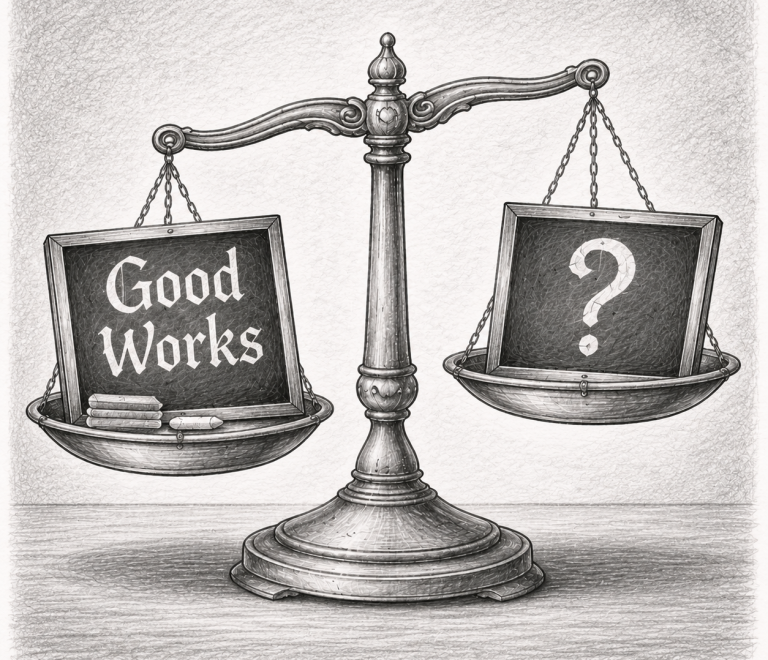
Good Works Before Conversion? The Biblical Perspective
You can find the original text in German here...
1. The Urge to Make Restitution, the Awareness of Guilt
In times of spiritual awakening, a person’s eyes are opened to his spiritual corruption. The sins that he once regarded as insignificant now appear in their unbearable ugliness and wickedness. Sorrow and shame overwhelm the penitent. Naturally, he desires to make everything right as quickly as possible and would gladly erase every remembrance of his wrongdoing. He wonders how he could appear so defiled before God. Some even think that, in order to be justified, they must punish themselves. Self-mortification, fasting, and voluntary deprivation are common in many religions. Even among some evangelical movements such practices are found. In the Roman Catholic Church, people who practiced such acts were even canonized, such as Heinrich Suso, Adelheid Langmann, and many others.
When someone sincerely desires to make everything right with God, such acts of remorse may at first appear to be proper. But we want to examine this seemingly righteous approach in the light of the Word of God. What kind of conduct is pleasing to God when we have set our hearts on drawing near to Him? What offerings does God desire from us, and what conditions does He require? Here it is important to know more about God Himself and to understand His requirements more fully.
We find a profound statement in Isa. 42:5: "Thus saith God the LORD, he that created the heavens, and stretched them out; he that spread forth the earth, and that which cometh out of it; he that giveth breath unto the people upon it, and spirit to them that walk therein." This verse reveals the greatness of God. Everything comes from Him, and everything is in His hand. With our limited understanding, we are unable to comprehend the greatness and power of this mighty God. Merely attempting to recall the variety of the plant and animal kingdoms causes man's thoughts to lose themselves in their seemingly immeasurable abundance. He has not only created the heavens, the earth, and everything in them, but He has also created man. He has determined what is good for man. He has given him His commandments. What measure of punishment should be required for the transgression of those commandments? Will He be satisfied if we attempt, according to our own ideas, to lessen or even remove our guilt through good works or self-inflicted punishment?
2. What Price Must Be Paid to Make Restitution?
Now let us consider from the Scriptures whether self-imposed punishments and sacrifices are sufficient and whether they meet the requirements of the great God.
Already in the Old Covenant we find that, according to the Law, no defective or blemished sacrifice could be offered to God. Every sacrifice appointed for the people of Israel had to be without blemish (cf. Lev. 1:3; Lev. 3:1). Yet even these sacrifices, ordained by God, were not perfect, chiefly because they were not of equal value. A lamb or a bull is not equal in value to a human being. These sacrifices were appointed by God only temporarily. They were merely a shadow of the better sacrifice that was yet to come according to God's plan (cf. Col. 2:17; Heb. 10:1).
Here lies the very heart of the glad tidings: God Himself offered His most precious gift—His only beloved Son—as the sacrifice for us. In II Cor. 5:18 we read, "And all things are of God, who hath reconciled us to himself by Jesus Christ, and hath given to us the ministry of reconciliation."
There is now no other means by which sin can be blotted out. It must therefore become clear that, with regard to the forgiveness of sins, there can be no human contribution. Why is this so? Let us consider the reasons more closely.
3.Reasons Why There Can Be No Human Contribution
a) No offering that we could bring can lessen our guilt in the slightest degree. Since everything was created by God, nothing in this world truly belongs to us. We have nothing that we can "give" to God. God says in Ps. 50:9-12: "I will take no bullock out of thy house, nor he goats out of thy folds. For every beast of the forest is mine, and the cattle upon a thousand hills. I know all the fowls of the mountains: and the wild beasts of the field are mine. If I were hungry, I would not tell thee: for the world is mine, and the fulness thereof." One could also say that all the gold on earth and every precious stone belong to Him. Furthermore, it must be remembered that the Ruler of the universe has no need of money or of any earthly possession.
b) There is no other price and no other payment for our sins except blood. Since the Scriptures declare that the life of the flesh is in the blood (Lev. 17:11), every sin must necessarily be atoned for through the shedding of blood. Therefore, blood is the only means by which sin can be removed. "And almost all things are by the law purged with blood; and without shedding of blood is no remission" (Heb. 9:22). Christ paid the price for us. "He blotted out the handwriting of ordinances that was against us" (Col. 2:14). Through His blood He redeemed us and sanctified us unto Himself (cf. Acts 20:28; Heb. 13:12).
c) There are no good works by which we can purchase our own forgiveness. Christ "saved us, not by works of righteousness which we have done" (Tit. 3:5).
First, if someone has been sentenced to death and must pay for his transgression with his life, he cannot save his life by performing good works. The value of his works cannot replace the value of his life. "Wherefore, as by one man sin entered into the world, and death by sin; and so death passed upon all men, for that all have sinned" (Rom. 5:12; cf. also Rom. 1:32).
Second, if forgiveness could be obtained through good works, then it would be earned as a reward rather than received by grace. But salvation is given solely by grace. "And if by grace, then is it no more of works: otherwise grace is no more grace" (Rom. 11:6).
It should also be noted that even under the Old Covenant salvation was received by faith alone. The Scriptures say of Abraham: "For if Abraham were justified by works, he hath whereof to glory; but not before God. For what saith the scripture? Abraham believed God, and it was counted unto him for righteousness. Now to him that worketh is the reward not reckoned of grace, but of debt. But to him that worketh not, but believeth on him that justifieth the ungodly, his faith is counted for righteousness" (Rom. 4:2-5; see also II Cor. 5:18-19).
The Jews asked Jesus directly, "What shall we do, that we might work the works of God?" Jesus answered, "This is the work of God, that ye believe on him whom he hath sent" (John 6:28-29).
d) There is no other way of salvation except through Jesus Christ alone. "Neither is there salvation in any other: for there is none other name under heaven given among men, whereby we must be saved" (Acts 4:12).
Furthermore, we read in I Cor. 15:21-22: "For since by man came death, by man came also the resurrection of the dead. For as in Adam all die, even so in Christ shall all be made alive."
Likewise, I John 2:2 clearly teaches that Jesus came into the world to make atonement for the sins of all mankind: "And he is the propitiation for our sins: and not for ours only, but also for the sins of the whole world."
4. Double Guilt
Someone may think that he must first make restitution himself and only afterward ask God for forgiveness. We would remind such a person that everyone who has committed an offense against another person has also sinned against God. He stands guilty before both God and man. Thus there is a twofold obligation of restitution. Let us illustrate this with an example. If someone has stolen something, he is guilty before the injured person and must return what was stolen or restore its value. Yet even more important is the fact that he has transgressed the commandment of Almighty God. As far as his guilt before God is concerned, making restitution to the injured person accomplishes nothing. Even if everything stolen has been returned and every other wrong has been made right, the violation of God's commandment has still not been atoned for. Here only prayer and faith in the blood of Jesus Christ can make everything right.
Surely Satan wants to push the most important matter—the salvation of the soul—into the background and place the emphasis on what is secondary, namely, making restitution to men. Teachings that establish such an order originate with Satan and are indeed important to him. Restitution toward men may require much time. During that time, the working of the Spirit of God may diminish or even cease altogether. The authors of this article know of a case in which the salvation of a soul was delayed in this way, and the person afterward never received God's forgiveness.
In order to bring people into even greater difficulty, Satan seeks to change the order established by Jesus. Jesus said, "Thou blind Pharisee, cleanse first that which is within the cup and platter, that the outside of them may be clean also" (Matt. 23:26). First the heart must be cleansed, and only afterward the matters concerning our fellow men. The words of Jesus also reveal the nature and motives of such people. He was speaking here to the Pharisees, who sought to be saved through their own righteousness. These Pharisees were "blind"—they did not see the true way of salvation.
5. To Whom Belongs the Glory?
Satan is also eager to use every attempt at self-righteousness in order to diminish the work of Jesus. He seeks to lessen the glory that belongs to God alone. It then appears as though man could contribute something toward his redemption through Christ by his own works. But this would mean that God's plan of salvation is defective and incomplete. Yet God does not regard these seemingly good works as truly good. Jesus said, "Either make the tree good, and his fruit good; or else make the tree corrupt, and his fruit corrupt: for the tree is known by his fruit. O generation of vipers, how can ye, being evil, speak good things?" (Matt. 12:33, 34). God Himself is the source of all that is good. "None is good, save one, that is, God" (Luke 18:19). Until that which is good—God Himself—reigns in our hearts and we are reconciled to Him, we cannot perform anything that is good in His sight.
6. The Detours and the Goal
Peace of heart and rest of spirit come only through faith in the forgiving blood of Jesus Christ. Martin Luther also came to this realization after passing through severe struggles. Although he was not conscious of any outward sin, he was tormented by a guilty conscience. He tried in vain to overcome faults in conduct, impure words, and sinful thoughts. Neither good works nor pilgrimages, neither long hours of prayer nor self-scourgings—nothing could quiet his conscience. In discouragement he exclaimed, "The more one tries to wash his hands, the dirtier they become." Only when he read the words of Rom. 1:17, "The just shall live by faith," did he lay hold of salvation by faith and obtain the longed-for peace with God.
Martin Luther's experience is an example of the condition of all people. In most cases they must discover that, without God, they have no strength to make restitution or to change their character. Their doubts, fears, weaknesses, and discouragement show them all too plainly their own helplessness and inability. Spiritually speaking, they are sick. It was for such people that Jesus came. He said, "They that are whole need not a physician; but they that are sick: I came not to call the righteous, but sinners to repentance" (Luke 5:31, 32). Satan wants to persuade people that they must first heal themselves and only afterward come to God.
But God alone can give the strength for every good work. If someone has made attempts to free himself or has made restitution in certain matters before coming to God, this does not invalidate his conversion. It simply means that he did not take the shortest path appointed by God and therefore had to endure additional struggles.
7. Conclusion
Someone may object that practical restitution with our fellow men is ordained by God and is therefore important and necessary. The same is true of fasting and humbling ourselves before God—they are certainly biblical. Indeed they are. The issue here, however, is the emphasis and the order. We may fast and humble ourselves before God, but what is decisive for our salvation is repentance and the prayer of faith. We must restore what has been stolen, but first the most important matter for our soul must be settled. First everything must be made right with God, and only afterward with our fellow men.