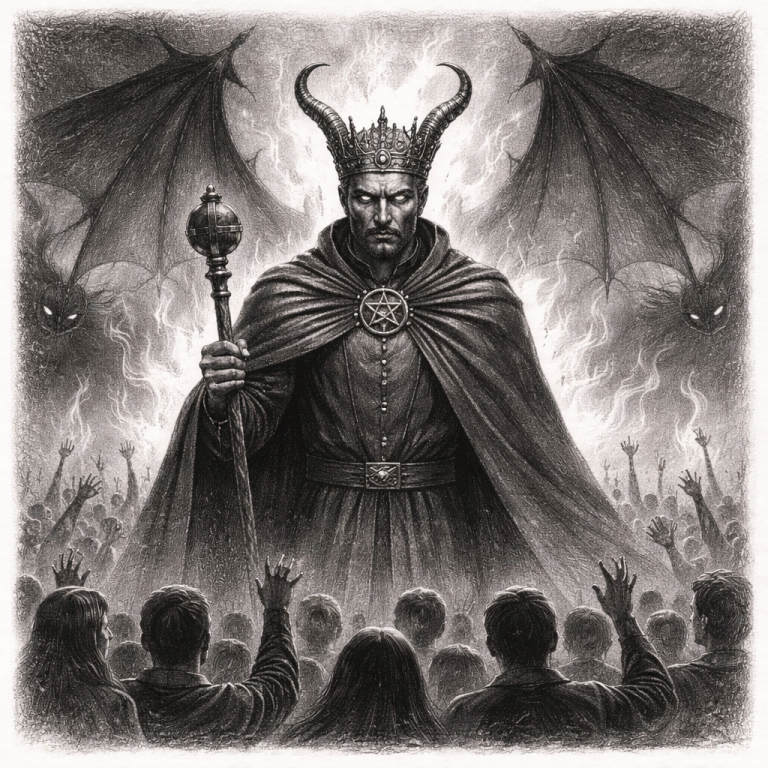
How do you imagine an Antichrist?
There are many different opinions and interpretations concerning the Antichrist. Throughout history, depending upon the country and the circumstances of the time, people have imagined the Antichrist in various ways as the embodiment of evil. Most commonly, anti-Christian political systems or even governments are identified as the Antichrist. Others portray the Antichrist as a single individual—a false teacher and enemy of Jesus Christ—who will lead Christians away from the faith. Especially in connection with end-time events, political leaders such as presidents or dictators are often regarded as the Antichrist.
You can find the original text in German here...
Who Is the Antichrist?
The term Antichrist comes from the Greek and is composed of the prefix anti, meaning "against" (originally, "in the place of"), and Christos, meaning "the Anointed One" (ἀντίχριστος). In classical Greek, the preposition anti originally meant instead of and later came to mean against. The word Antichrist appears only five times in the Bible, and only in John's Epistles. Let us carefully examine these passages.
1–2) I John 2:18-19
"Little children, it is the last time: and as ye have heard that antichrist shall come, even now are there many antichrists... They went out from us, but they were not of us..."
3) I John 2:22
"Who is a liar but he that denieth that Jesus is the Christ? He is antichrist, that denieth the Father and the Son."
4) I John 4:1-3
"Beloved, believe not every spirit, but try the spirits whether they are of God... Every spirit that confesseth that Jesus Christ is come in the flesh is of God... and this is that spirit of antichrist..."
5) II John 7
"For many deceivers are entered into the world, who confess not that Jesus Christ is come in the flesh. This is a deceiver and an antichrist."
Already the first passage demonstrates how unfounded the common view is that portrays the Antichrist as a single evil superhuman or supernatural being. The Apostle plainly states that there are "many antichrists," and that they had appeared "even now." He further says that "they went out from us." This does not fit the widespread interpretation at all. One can only wonder how readily interpretations are accepted without careful examination. (Since the whole Bible is inspired by one God through one Holy Spirit, a correct interpretation must harmonize with the entire Scriptures and never produce contradictions.)
To interpret these passages correctly, we must consider not only the content of the Epistle and the people to whom it was written, but also the problems and conflicts of that time. Why does the Apostle John warn that "many false prophets are gone out into the world"? Why does he repeatedly connect this warning with the rejection of our Lord Jesus?
The Apostle John belonged to the Jewish nation, and Christianity itself had its origin among the Jews. Every student of Scripture knows that the Jews looked forward with great expectation to the coming of their Messiah. The Samaritan woman said to Jesus, "I know that Messias cometh, which is called Christ..." (John 4:25; see also Matt. 2:4). It is equally well known that the Jews rejected Jesus, the King crowned with thorns, whom they had mocked and scourged. When Pilate offered to release Him, they cried, "Away with him... crucify him!" (John 19:15). To this very day they continue to wait for their Anointed One—the Messiah in Hebrew, the Christ in Greek. Therefore, even today many deny that Jesus is the Christ (I John 2:22). The humble appearance of Jesus as the suffering Servant is offensive to human pride, and for that reason many refuse to acknowledge Him (I John 4:1-3).
In general, all people can be divided into three groups: those who are true believers according to the standard of Scripture, who in the following will simply be called "believers," and "unbelievers," who do not believe in God. In John 17:9–16, Jesus makes a clear distinction between those who are "of the world" and those who are "not of the world." For example, in verse 9 He says: "I pray for them. I do not pray for the world but for those whom You have given Me, for they are Yours." (John 17:9)
The third group consists of those who consider themselves believers but reject the humble and self-sacrificing walk exemplified by Christ and therefore actually stand opposed to the work of Christ. The Apostle John calls them antichrists.
Therefore John writes: "...even now many antichrists have come... They went out from us, but they were not of us; for if they had been of us, they would have continued with us; but they went out that they might be made manifest, that none of them were of us..." (1 John 2:18–19) This designation was necessary to identify those false Christians whose attitude is contrary to the character of Jesus—His self-sacrifice, love, humility, and obedience. They are against (anti) such an Anointed One (Christ); therefore, they are antichrists.
The Apostle John also uses the general expression "Who is...?" He is not referring to one specific individual but to any such person. Thus, 1 John 2:22 may also be understood in this sense: "Who is a liar but he who denies that Jesus is the Christ? He is antichrist who denies the Father and the Son."
Likewise, 2 John 7 says: "For many deceivers have gone out into the world who do not confess Jesus Christ as coming in the flesh. This is a deceiver and an antichrist." In both passages the Apostle John explains exactly which people he regarded as antichrists. One can only marvel at how imaginative some interpreters have become and how seldom people read and examine these statements in Scripture for themselves.
Someone may object, "It does not really matter how we understand this term." Perhaps that would be true if such interpretations had no consequences. But the false teaching concerning the Antichrist diverts the attention of believers away from the necessity of keeping themselves pure from sin and from the world, and instead focuses their attention on discussions about political figures and world events. It is the purpose of the enemy of our souls to direct people's attention to temporary and insignificant things, so that they fail to reach the true goal—to see souls saved for heaven.
False Christs
The passages Matthew 24:24 and Mark 13:22 are also frequently associated with the Antichrist. Let us read Matthew 24:23 together with verse 24: "Then if anyone says to you, 'Look, here is the Christ!' or 'There!' do not believe it. For false christs and false prophets will arise and perform great signs and wonders, so as to deceive, if possible, even the elect."
A similar statement appears in Mark 13:22. Likewise, Matthew 24:5 says: "For many will come in My name, saying, 'I am the Christ,' and they will deceive many."
The Greek text uses the word pseudochristos ("false" or "counterfeit Christ"). Therefore, these passages are not speaking about the Antichrist. They do not refer to those who are against the Anointed One (see the explanation under "Who Is the Antichrist"). Rather, they refer to false prophets who present themselves as the Christ, the promised Messiah. Even if they perform signs and wonders, they are not to be believed. Such people already existed in the days of the Apostle John, and they will continue to appear throughout history. Sadly, many people to this day have either never read this warning or have failed to heed it.
One example is José Luis De Jesús Miranda, who lived in the U.S. state of Florida and was the president and founder of the international ministry Growing In Grace, Inc. He claimed that in 1974, while in a hall of marble, he had been transformed into Jesus Christ through a spirit. At first he called himself "The Other One," and from 2004 onward simply "Jesus." He reportedly had about 100,000 followers and claimed that sin no longer exists and that the devil is dead. His followers wore T-shirts bearing his portrait together with the slogan "God Has Come." (as of 2012).
Similar claims were made by Inri Cristo from Brazil (German-language source: https://www.rtl.de/cms/ich-bin-jesus-mann-66-haelt-sich-fuer-den-sohn-gottes-1957071.html).
Unfortunately, reports of such individuals continue to appear. Another example, published in December 2019, may be found here (German-language source): https://www.nw.de/lokal/kreis_guetersloh/harsewinkel/22630501_Fahnder-finden-Drogen-im-Fitnessstudio-in-Harsewinkel.html
The Man of Lawlessness (II Thessalonians 2:3–10)
"Let no one deceive you in any way. For that day will not come unless the apostasy comes first, and the man of lawlessness (some ancient manuscripts read: the man of sin) is revealed, the son of destruction, who opposes and exalts himself above everything that is called God or is worshiped, so that he takes his seat in the temple of God, displaying himself as being God. Do you not remember that while I was still with you I told you these things? And now you know what restrains him, so that he may be revealed in his own time. For the mystery of lawlessness is already at work. Only he who now restrains it will do so until he is out of the way. And then the lawless one will be revealed, whom the Lord Jesus will kill with the breath of his mouth and bring to nothing by the appearance of his coming. The coming of the lawless one is by the activity of Satan with all power and false signs and wonders, and with all wicked deception for those who are perishing, because they refused to love the truth and so be saved.”
These verses are also associated with the subject of the Antichrist, even though the word "Antichrist" does not appear here even once. Upon closer examination, we will present several arguments that speak against such an interpretation. Let us first summarize the characteristics of this supposed "Antichrist" described in these verses and then compare them with other passages of Scripture:
- the apostasy comes first, and the man of lawlessness is revealed (v. 3)
- then this person takes his seat in the temple of God and claims to be God (v. 4)
- he will be powerful and perform signs and wonders, but at the coming of the Lord he will be destroyed by the breath of His mouth (v. 8)
Argument 1
According to verses 3 and 4, the coming of the "man of lawlessness" and the apostasy occur at the same time. It is evident that the spiritual apostasy has long since come, yet this particular man has not appeared up to the present day. A full description of the spiritual decline that followed the age of the first Christians could fill an entire volume. Therefore, we will mention only some of its most significant characteristics:
– The gradual replacement of the authority of the Word of God by human commandments and traditions—this began with the First Council of Nicaea in A.D. 325.
– The introduction of numerous false doctrines, such as salvation through works, the intercession of Mary, infant baptism, and many others.
– The development of hierarchical structures within the Church, which ultimately culminated in the establishment of the papal office.
– The recognition of church or congregational membership through registration in church records or membership rolls.
These and many other teachings and practices are found neither in the book of Acts nor in any other descriptions of that period. The apostasy is therefore already evident in the earliest centuries. And together with that apostasy in the first centuries, the Antichrist also appeared.
Argument 2
In order for someone to take his seat in the temple, the stone temple in Jerusalem would first have to be rebuilt and temple worship restored. But that is impossible. According to Scripture, Christ has been given "all authority in heaven and on earth" (cf. Matthew 28:18). He has entered into His eternal spiritual kingdom, and for believers He is the end of the Law (cf. Romans 10:4). Consequently, the Old Covenant with its sacrifices—and with it the temple built of stones—has no further place until the second coming of Christ for judgment. We believe that it will never be rebuilt. Therefore, the temple mentioned here must not be understood literally but spiritually. Paul explains that the true children of God are the temple of God (cf. 1 Corinthians 3:16). God dwells in the hearts of His children (cf. John 14:23). More on this subject can be found in the article "The Kingdom of God."
Argument 3
In II Thessalonians 2:1, Paul speaks about the return of Christ and then explains who "the man of lawlessness" is. According to this passage, this person must perform signs and wonders before the coming of the Lord—events that would surely attract the attention of the entire world. If he were the "Antichrist" believed in by many religious groups, he could not appear unnoticed or merely on a local scale. Rather, it would have to be an event of such magnitude that it would cause worldwide attention. Furthermore, such an event would have to be recognized as a certain sign of Christ's imminent return.
Yet here again, the view that these verses describe a single personal Antichrist contradicts other passages of Scripture. The Bible says that Jesus will come "like a thief in the night"—that is, without prior announcement (cf. I Thessalonians 5:2). In Matthew 24:37–38 we find a description of the carefree attitude of those days:
"For as were the days of Noah, so will be the coming of the Son of Man. For as in those days before the flood they were eating and drinking, marrying and giving in marriage, until the day Noah entered the ark..."
Thus, immediately before the Lord's return there will be no extraordinary excitement, and everything will continue in its ordinary course. There is no room here for the appearance of a personal Antichrist.
There remains only one way to explain these verses correctly: we must understand the "man of lawlessness" not as one particular individual, but as a collective designation for a particular group of people. Upon closer examination, all these descriptions fit the Pope. The title "Pope" refers both to the individual person and to the office itself—that is, to all popes.
This "man of destruction" will be proud; he "exalts himself above all" and takes honor for himself instead of giving it to God (II Thessalonians 2:3). He takes his seat in the temple—that is, among the believers, placing himself at their head (cf. I Corinthians 3:17)—and "displays himself as being God." The popes claim to be the highest authority for believers within the Roman Catholic Church. The Pope is regarded as the one and only true representative of Christ, and therefore also God's representative on earth. He claims the authority to forgive sins. Among his followers, his decrees are regarded as having greater authority than the Bible itself, the Word of God.
Here are several examples that aptly characterize certain popes as "men of lawlessness" (or of sin):
- Gregory "the Great" (pontificate: A.D. 590–604) promoted superstition and the fear of hell, justified the practice of slavery common within church circles as well as the torture of those holding different beliefs, and hailed the usurper Phocas, who had murdered the Byzantine Emperor Maurice together with his entire family, as a "messenger of the merciful God." (Source: Karlheinz Deschner, Kriminalgeschichte des Christentums [Criminal History of Christianity], Vol. 4, p. 196.)
- After the death of Agapetus II, Octavian was elected pope on December 16, 955, at the age of sixteen (according to other sources, eighteen), taking the name John XII. He is described as being uneducated and capable only of speaking the common vernacular. According to the historian and bishop Liutprand of Cremona, he was accused of blasphemy, perjury, murder, mutilation, adultery, incest, and an obsession with hunting and gambling. He is also said to have given sacred vessels to prostitutes. It is even alleged that he ordained a deacon in a horse stable. See the referenced source.
- Pope Innocent VIII entered church history as one who secured his election on August 29, 1484, by bribing the cardinals during the night before the vote. He has likewise been accused of arranging assassinations, practicing usury, living in concubinage with two of his nieces, fathering children with them, and using indulgence money to finance a war. (German-language source: http://www.universelles-leben.org/cms/wer-sitzt-auf-dem-stuhl-petri/teil-9.html)
- Peter of Candia (1340–1410), Cardinal of Milan, was elected pope by twenty-four cardinals at the age of seventy and was consecrated under the name Alexander V. "Yet the two popes in Avignon and Rome disregarded the decisions of the council and continued, without concern, to exercise their functions as the legitimate popes. Benedict continued to hurl his curses and excommunications against the council and his rivals; Gregory did the same after forming an alliance with Ladislaus, the ambitious King of Naples. Alexander, who had not yet gained possession of the See and the Patrimony of Peter, in turn excommunicated Benedict, Gregory, and Ladislaus." (From: Andrew Müller, History of the Christian Church, p. 65.) See the referenced source.
There are many more examples. Some of them can be found here (German-language website): https://www.theologe.de/reichtum_der_kirche_ist_blutgeld.htm.
Against this background, the designation "the man of lawlessness" appears highly appropriate for them—"who opposes and exalts himself above everything that is called God or is worshiped." Although miracles also occur within the church, this entire ecclesiastical power "the Lord Jesus will overthrow with the breath of His mouth and destroy by the appearance of His coming" (II Thessalonians 2:8).
Conclusion on the Topic of the Antichrist
If such a superhuman—such an Antichrist—were to come, Jesus and the apostles would warn us repeatedly and in clear, unmistakable terms. Yet this is not the case. It is evident that the idea of such an Antichrist is meant to distract Christians from fighting the spiritual battle and instead direct their attention toward a fleshly one. Compare 2 Corinthians 10:3–4: “For though we walk in the flesh, we do not wage war according to the flesh; for the weapons of our warfare are not of the flesh…”
The teaching about a personal Antichrist diverts the children of God into speculative discussions about politics and world wars instead of directing their attention toward preparing to meet Jesus in holiness and watchfulness. That is exactly what Satan desires!
1 Peter 1:13–15: “Therefore, prepare your minds for action; be sober-minded; set your hope fully on the grace that will be brought to you at the revelation of Jesus Christ. As obedient children, do not be conformed to the evil desires you had when you lived in ignorance. But just as He who called you is holy, so be holy in all your conduct.” (New International Version)